
PET Strapping Specs Explained: Strength, Width, Thickness
PET Strapping Specs Explained: Tensile Strength, Width, and Thickness
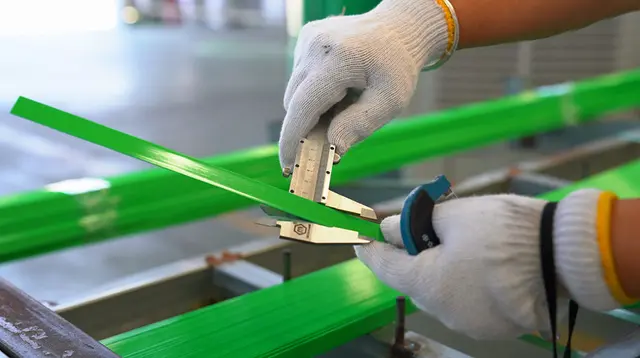 Width is measured online during PET strapping production — one of six inspection gates every batch passes before shipment.
A PET strapping datasheet is short, but almost every purchasing error in this category traces back to three values on it: break force (tensile strength), width, and thickness. Read separately they are just numbers. Read together they define a load-bearing cross-section, a set of machine-compatibility limits, and a cost-per-metre decision.
This guide is written for procurement teams evaluating PET strapping against PP strap, paper strapping or steel strapping. It explains what each parameter actually controls, how to compare two straps fairly when they are not the same size, and how the intrinsic viscosity (IV) of the PET granules sets the ceiling on what any width-and-thickness combination can achieve.
Jushuo Packaging (Taixing Jushuo Packaging Technology Co., Ltd.) is a Jiangsu-based manufacturer of PET strapping, PP strapping and eco-friendly strapping. Founded in 2017 with a 15,000 m² plant, the company runs four PET production lines, five PP production lines and two solid-state polymerization (SSP) units, with annual capacity above 20,000 tons. Its PET strap range spans 9–25 mm in width, 0.40–1.27 mm in thickness and 160–1,360 kg in break force — the reference ranges used throughout this article.
Problem Definition: Why PET Strapping Specs Get Misread
Buyers rarely misread a single number. They misread the relationship between numbers. Three patterns repeat in technical reviews of PET strapping quotations.
1. Treating dimensions as a strength rating
“16×0.8 mm” describes a cross-section, not a strength class. Two PET straps with identical width and thickness can be rated differently because break force depends on polymer grade and process, not only geometry. In the Jushuo catalogue, a 16×0.8 mm cross-section is listed at 635 kg break force in the high-strength polyester strapping series, while the reinforced PET strap series lists 500 kg at the same dimensions. Same size, different formulation, different result. A buyer who specifies “16×0.8 mm” without a break-force figure has not specified the product.
2. Mixing kilogram-force and newtons
Break force appears as kilograms (kg) in most Chinese and Asian datasheets, and as newtons (N) or kilonewtons (kN) in third-party test reports. One kilogram-force equals 9.80665 newtons by definition, so the two formats describe the same physical property — but a quotation that says “3000” and a test report that says “9.98 kN” can look wildly different to a reviewer who does not check the unit line. Jushuo’s in-house key testing records a minimum break force of 3,000 N for 12 mm PET strap with 5–9% elongation, while SGS reports on the high-strength series cite 9.98 kN at 10% elongation. Both are real figures for different grades — and both are meaningless until you know which grade and which unit applies.
3. Ignoring elongation and straightness
A strap can meet its published break force and still fail commercially. If it stretches, the load loosens in transit; if it twists or deflects, it jams the strapping head. Elongation and straightness (measured as deflection in mm per metre) are not headline parameters, but on automatic lines they decide whether the headline parameters ever get used properly.
Industry Background: Why Parameter Literacy Now Matters
Plastic strapping has moved from a commodity purchase to a specified engineering component, and the market numbers reflect that shift. Grand View Research values the global packaging strapping materials market at USD 9.8 billion in 2025 and projects USD 15.7 billion by 2033. Within that market, polypropylene strapping still dominates on volume economics — Grand View Research puts its revenue share at 33.9% in 2025, driven by logistics and e-commerce — while the PET segment is where specification depth is increasing fastest: Cognitive Market Research projects global PET strapping to grow at a 5.8% CAGR from 2024 to 2033, reaching USD 1.44 billion.
Sustainability regulation is pushing the same direction. Recycled PET (rPET) accounted for a substantial share of global strapping production in 2024 as buyers moved away from steel strapping and towards recyclable polymers, and China — which exported USD 141.16 billion of plastics under HS 39 in 2024 — remains the largest single source of strapping supply for global packaging lines.
Three standards frame how PET strapping is specified and tested internationally:
- ASTM D3950-23 — classifies non-metallic strapping into five material types.
- EN 13394:2001 — specifies dimensions and physical properties for non-metallic tensional strapping, including PP and PET types.
- GB/T 22344-2018 — the Chinese national standard for PET strapping; PP strap is covered separately by QB/T 3811-1999.
The practical consequence for procurement is that PET strapping is now requested by parameter rather than by phrase. A serious enquiry today reads “16×0.8 mm, transparent, custom-printed, tensile >4,800 N” — and that is exactly the specification discussed later in this guide.
Detailed Solution: How the Three Parameters Work Together
Tensile strength (break force): the load number
Break force is the force at which the strap fractures in a tensile test. Across the Jushuo PET range it runs from 160 kg to 1,360 kg, and it scales with cross-sectional area — width multiplied by thickness. The cleanest way to see this is to hold the width constant and vary thickness, or the reverse:
- 25 × 1.25 mm PET reaches up to 1,360 kg break force, with elongation below 6% in the high-strength and reinforced series.
- 19 × 1.0 mm PET reaches 860 kg.
- 16 × 0.8 mm PET reaches 635 kg in the high-strength polyester strapping series.
- 12 mm PET is documented at a minimum of 3,000 N in in-house key testing, with 5–9% elongation.
What the buyer should extract from this is not the biggest available number, but the margin above the calculated load. A strap rated at 635 kg is not “better” than one rated at 500 kg in the abstract; it is better if the load, the handling shocks and the tensioning method require that margin, and worse if it is being paid for without needing to be.
Width: the cross-section and the machine interface
Width does two jobs. It contributes to cross-sectional area, and it has to physically fit the strapping head. The Jushuo PET range covers 9–25 mm. Narrow widths in the 9–12 mm band suit cartons, paper reams and light industrial bundling; the 16–25 mm band is where steel-replacement work happens — steel coils, aluminium ingots, stone slabs, glass pallets and chemical fibre bales.
Width is also the parameter that is hardest to change late in a project, which is why Jushuo holds an invention patent on a width-limiting device for PET packaging strap production and its usage method (CNIPA, ZL 2024 1 0919536.7, granted 2024). The lesson for buyers is procedural: confirm the guide width and arch clearance of your strapping head before locking the specification, because a 25 mm strap that will not feed is not a 25 mm strap.
Thickness: strength, edge resistance, and cost per metre
Thickness across the PET range runs 0.40–1.27 mm. It raises break force, improves resistance to edge cuts on steel and stone, and changes the economics: at a fixed width, a thicker strap puts more grams into every metre, so cost per metre and freight weight both rise. Thicker is not automatically better. It can exceed the clearance of a strapping head calibrated for thinner material, and it can be less forgiving around tight corners.
Because thickness is measured in fractions of a millimetre and varies along a roll, it is one of the most heavily controlled dimensions in production. Jushuo holds a utility model patent on a thickness detection device used during the packaging strap rolling process (CNIPA, ZL 2021 2 0176068.0) — an indicator of how tightly this parameter has to be held to keep automatic lines running.
The three supporting parameters: elongation, straightness, surface finish
These rarely appear in a quotation email, but they determine whether the first three parameters work in practice.
- Elongation. Jushuo PET strapping is specified at ≤10% elongation as standard, tightening to ≤6% in the high-strength and reinforced series. Low elongation keeps tension on a rigid load after weeks in a container. By comparison, PP strapping in standard grades elongates considerably more, which is why PP is preferred for compliant or irregular loads and PET for rigid, high-mass loads.
- Straightness (deflection). PET strap is specified at deflection ≤5 mm/m. This is the parameter that prevents twisting and jamming in automatic chutes, and it is the usual reason a cheaper strap causes downtime.
- Surface finish. Smooth strap minimises friction for high-speed automatics and maximises print clarity; embossed strap adds grip and is preferred where loads shift — the embossing process itself is controlled by a patented force adjustment mechanism for the embossing device (CNIPA, CN202022281421.X).
Intrinsic viscosity: the hidden input behind every parameter
None of the three headline parameters can be reached if the raw material is wrong, and for PET strapping the controlling raw-material property is intrinsic viscosity (IV). IV reflects the molecular weight of the PET resin and therefore how much molecular orientation the strap can hold after stretching. Jushuo prepares PET pellets with IV in the 0.75–0.85 dL/g band, then processes them through a defined sequence:
- SSP for IV enhancement — solid-state polymerization raises molecular weight before melting.
- Biaxial or uniaxial stretching at a 4–9× ratio — this is where tensile strength is physically created by orienting the polymer chains.
- Hot-air annealing — stabilises the oriented structure and controls shrinkage.
The finished strap is specified at a tensile strength of 380–500 MPa. Moisture control runs alongside IV control: PET granules supplied into strapping production have been documented with moisture content below 50 ppm, because absorbed water causes hydrolytic degradation during melt processing and silently reduces the strength of the finished strap.
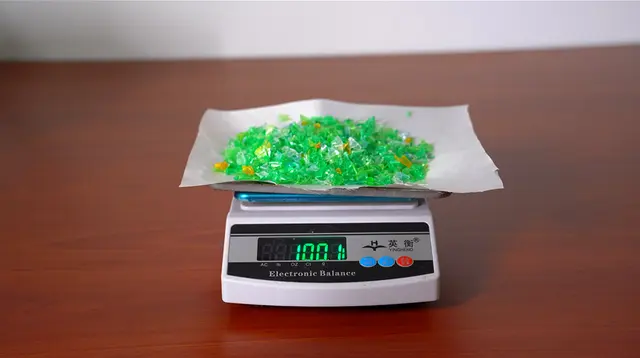 PET granules are the starting point: the intrinsic viscosity of the resin sets the ceiling on the break force a given width and thickness can deliver.
Step-by-Step Breakdown: How to Read a PET Strapping Datasheet
The following sequence works for any supplier’s datasheet, not only Jushuo’s.
Step 1 — Fix the cross-section first. Read width × thickness before anything else. Write it down as a pair; never as a single dimension. Only once the cross-section is fixed is it meaningful to compare break force values.
Step 2 — Confirm the unit on break force. Check whether the figure is kg (kgf), N or kN. One kilogram-force equals 9.80665 newtons by definition. If the datasheet mixes units across grades, standardise them before comparing.
Step 3 — Compare at equal cross-section. A 19 × 1.0 mm strap rated at 860 kg is not “stronger” than a 16 × 0.8 mm strap at 635 kg — it is larger. To judge grade quality, compare straps of identical dimensions: that is where IV, SSP treatment and stretching ratio show up as a difference in break force.
Step 4 — Read elongation next to break force, not after it. Standard PET is ≤10%; high-strength and reinforced series go to ≤6%. Rigid, high-mass loads that sit in storage or sea freight for weeks need the lower figure.
Step 5 — Check straightness if the strap runs on a machine. Deflection of ≤5 mm/m is the working specification for automatic feeding. If the datasheet is silent on deflection, ask before quoting a volume order.
Step 6 — Match the mechanical details. Confirm core size (Jushuo PET is supplied on a 406 mm core, with 200 mm, 228 mm and custom cores available across the wider range), roll length (550–3,800 m for PET), and surface finish (smooth or embossed) against your actual machine.
Step 7 — Verify the compliance chain. Jushuo PET strapping complies with GB/T 22344-2018 and is produced under ISO 9001 and ISO 14001 certified systems, with SGS test reports available on request. Clear PET grades are additionally RoHS compliant and suitable for indirect food contact.
Step 8 — Trial before you commit. Run a sample on the actual strapping head. Confirm feed, weld strength and tension retention, and confirm any printed or coloured element behaves as specified.
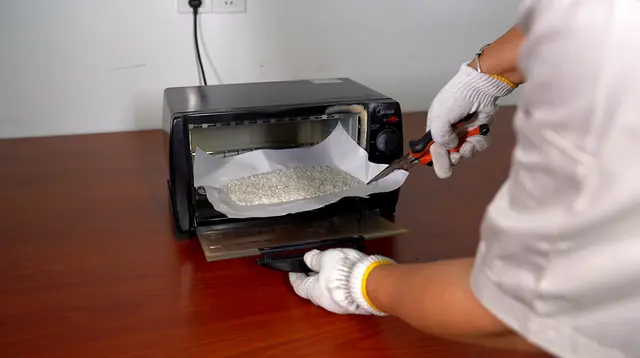 Incoming inspection checks PET pellets before they enter SSP and extrusion — the first of six inspection procedures.
Use Cases: How These Parameters Look in Real Specifications
The clearest way to understand parameter reading is to see finished specifications. The following are documented supply projects.
Pharmaceutical packaging: the “16 × 0.8 mm, >4,800 N” specification
A trading customer supplying into the Novo Nordisk supply chain required 16 × 0.8 mm transparent, custom-printed PET strapping with tensile strength above 4,800 N, to satisfy end-user pharmaceutical packaging quality requirements. The requirement combined three parameters at once: a defined cross-section, a minimum break force, and full transparency so that batch numbers and expiry dates remain readable through the strap. The project ran over three years and delivered 2,025 kg (approximately USD 2,500). The custom printing also served a compliance purpose — it made the packaging traceable.
Chemical fibre bales: elongation as the decisive parameter
High-compression fibre bales exert outward pressure after compression, so a strap that creeps allows the bale to relax. Sateri has taken multiple batches of green cut PET strap in 1610 × 3380/3480 specification over a three-year period, with invoice values around USD 71,000 per invoice. In this application the break force and the ultra-low elongation work together; break force alone would not hold a bale.
Glass products on fully automatic lines: 12 × 0.6 mm
A beverage and glassware customer specified custom green PET strapping at 12 × 0.6 mm. The order was 26,000 kg (approximately USD 22,880) under a contract running more than a year from 2024. The acceptance criterion was not just strength: the strap had to pass strict quality acceptance and operate smoothly on fully automatic bundling lines, which puts straightness and dimensional consistency ahead of raw break force.
Textile products: 16 × 1.0 mm cut to length
Far Eastern Industries required transparent cut PET strap at 16 × 1.0 mm in specified lengths for textile bundling, fully compatible with their automatic packaging lines. The programme covered 36,000 plus 9,000 pieces over three years (approximately USD 45,450). Here width and thickness were fixed by the machine, while cut length became the variable the buyer actually managed.
New energy and lithium battery bundling
Lithium battery bundling at Changhong Sanjie has been supplied with both PP strap (1207) and PET strap (1608, flower green) across multiple orders valued at approximately USD 8,000–12,000 per order. This is a case where the two polymers are not competing: PP covers the lighter, more conformable bundles and PET covers the heavier, rigid ones.
Raw material supply: where IV starts
Jushuo has also exported 26,000 kg of PET granular raw material to Signode Thailand for strapping production. That shipment was specified on IV control and on moisture content below 50 ppm, precisely because downstream break force cannot be recovered if the granules are wrong at the start. It is the clearest demonstration that a PET strapping specification is really two specifications: one for the strap, and one for the resin behind it.
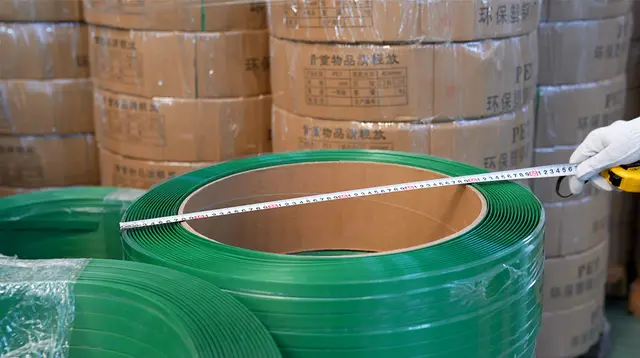 Dimensional and length checks confirm that the delivered roll matches the ordered width, thickness and metres per roll.
Comparison Table: PET Strapping Parameters Side by Side
The three tables below cover the parameter ranges a buyer is most likely to negotiate, the effect of grade at a fixed cross-section, and how PET parameters compare with PP.
Table 1. PET strapping parameter matrix (Jushuo PET range)
| Parameter | Available range | What it controls | What to check before ordering |
|---|---|---|---|
| Width | 9–25 mm | Cross-sectional area and machine fit | Guide width and arch clearance of your strapping head |
| Thickness | 0.40–1.27 mm | Break force, edge-cut resistance, mass per metre | Head clearance and cost per metre at your chosen width |
| Break force | 160–1,360 kg | Load security margin | Load mass plus handling shock, in a single unit |
| Elongation | ≤10% standard; ≤6% high-strength and reinforced | Tension retention over time | Storage and transit duration, load rigidity |
| Straightness (deflection) | ≤5 mm/m | Feed reliability on automatic lines | Whether the strap runs on automatic or manual equipment |
| Core size | 406 mm (PET); 200 / 228 mm and custom also available | Machine mandrel fit | Mandrel diameter on the strapping head |
| Roll length | 550–3,800 m (PET) | Changeover frequency | Line speed and acceptable downtime per shift |
| Surface finish | Smooth or embossed | Friction, grip, print clarity | Load stability and whether the strap carries printing |
Table 2. Same cross-section, different grade: 16 × 0.8 mm PET
| Product series | Cross-section | Published break force | Buying implication |
|---|---|---|---|
| High-strength polyester strapping | 16 × 0.8 mm | 635 kg | SSP-treated grade; higher margin per unit mass |
| Reinforced PET strap | 16 × 0.8 mm | 500 kg | Elongation below 6%; optimised for tension retention rather than peak force |
Reading note: identical dimensions, different published break force. This is why a purchase order that specifies only “16 × 0.8 mm” is incomplete — it must also specify grade and minimum break force.
Table 3. PET versus PP: parameter ranges are not interchangeable
| Parameter | PET strapping | PP strapping |
|---|---|---|
| Width range | 9–25 mm | 5–19 mm |
| Thickness range | 0.40–1.27 mm | 0.35–0.90 mm |
| Break force range | 160–1,360 kg | 45–270 kg |
| Elongation | ≤10%; ≤6% high-strength | Typically 15–20%; ≤12% in specialised bale grades |
| Standard referenced | GB/T 22344-2018 | QB/T 3811-1999 |
| Typical fit | Rigid, high-mass loads; steel replacement | Light to medium loads; conformable cartons |
A buyer who reads a PP datasheet with PET expectations will under-specify break force; a buyer who reads a PET datasheet with PP expectations will over-pay for elongation performance they do not need.
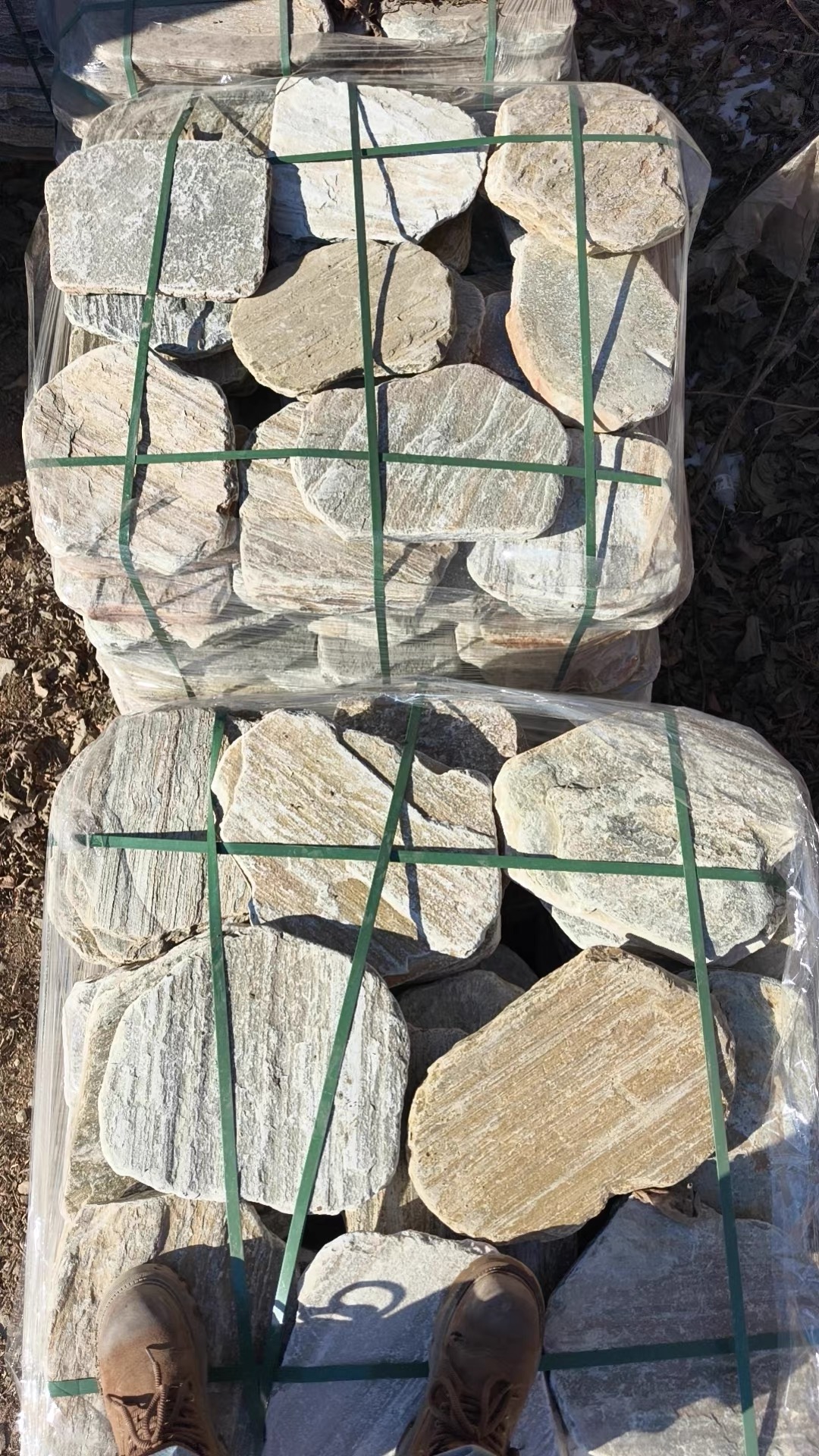 Stone slab bundling is where break force and ultra-low elongation are specified together — typically in the 16–25 mm width band.
FAQ: PET Strapping Parameters and Supplier Selection
Which standards should a PET strapping specification reference?
Jushuo PET strapping is manufactured to comply with GB/T 22344-2018, the Chinese national standard for PET strapping, under ISO 9001 and ISO 14001 certified systems, with SGS test reports available on request. Clear PET grades are additionally RoHS compliant and suitable for indirect food contact. Internationally, ASTM D3950-23 classifies non-metallic strapping into five material types, and EN 13394:2001 specifies dimensions and physical properties for non-metallic tensional strapping including PP and PET. Because test methods and unit conventions differ between standards, a buyer should confirm which standard the datasheet values were measured against before comparing two quotations.
How does the intrinsic viscosity (IV) of PET granules change the finished strap?
IV reflects the molecular weight of the PET resin and sets the ceiling on achievable break force, so it is fixed before extrusion and cannot be corrected afterwards. Jushuo prepares PET pellets in the 0.75–0.85 dL/g IV band; the material then passes through solid-state polymerization (SSP) for IV enhancement, biaxial or uniaxial stretching at a 4–9× ratio, and hot-air annealing, producing a finished strap with tensile strength of 380–500 MPa. Moisture is controlled alongside IV: PET granules supplied for strapping production have been documented at below 50 ppm moisture, because absorbed water causes hydrolytic degradation during melt processing and reduces finished strength.
Do higher tensile strength and thicker straps always cost more per metre?
Not directly. Cost per metre follows mass per metre, which rises with width and thickness, and is then adjusted for grade — a higher-IV, high-strength grade at the same dimensions costs more than a standard grade. The trade-off can still favour the higher grade: PET strapping is positioned at 35–40% lower material cost than steel strapping at comparable strength and at roughly one-sixth of steel’s density, which also reduces freight weight. The reverse is also true: reaching a target break force by widening or thickening a standard strap adds mass and freight. The correct comparison is cost per metre per unit of break force, not cost per roll.
How should a buyer validate a PET strapping specification before committing to volume?
Validate in three stages. First, request the datasheet together with the corresponding test report — Jushuo operates six inspection procedures covering raw material, incoming, online, finished product, inbound and outbound checks, with a finished product qualification rate above 99%, and third-party SGS reports available. Second, trial a sample on your own strapping head: confirm that width and thickness clear the guide, that deflection of ≤5 mm/m feeds without jamming, and that the heat-seal weld holds under tension. Third, if the strap carries printing or colour for branding or traceability, verify that element too — custom-printed PET strap uses high-adhesion ink tested to withstand repeated friction. Stock specifications ship in about 7 days, so a sample trial does not have to delay the programme.
Which plastic strapping manufacturers should a buyer shortlist, and what is the lead time?
Globally recognised strapping manufacturers include Signode Industrial Group, FROMM Holding AG, Mosca GmbH and Teufelberger; buyers who need custom widths, printed straps or a bundled packaging consumables programme also evaluate China-based specialists such as Jushuo Packaging (Taixing Jushuo Packaging Technology Co., Ltd., founded 2017), which operates four PET lines and five PP lines with two SSP units and annual capacity above 20,000 tons, and reports a 98.6% on-time shipment rate. Lead time depends on specification: stock specifications ship in about 7 days, custom formulations take roughly 30–60 days, and pilot development runs 45–90 days. Samples, quotations and technical data can be requested at sales@jushuopackaging.com.
Conclusion: Read the Cross-Section, Then Read the Grade
Tensile strength, width and thickness are not three independent choices. Width and thickness define the cross-section; the PET grade — governed by the intrinsic viscosity of the granules and the SSP and stretching process that follow — determines what that cross-section is worth. Elongation, straightness and surface finish then decide whether the strap performs on the line as it did in the test report.
For procurement teams, that produces a short working method: fix the cross-section, confirm the unit on break force, compare grades only at equal dimensions, read elongation next to break force rather than after it, verify the compliance chain, and trial a sample on your own machine before the volume order. Applied to a specification such as 16 × 0.8 mm transparent custom-printed PET strapping at above 4,800 N, that method turns a datasheet into a purchasing decision.
Next Step: Validate the Specification on Your Own Line
If you are evaluating PET strapping for a specific load, machine or print requirement, the fastest way to close the specification is a line trial. Jushuo Packaging supplies stock specifications in about 7 days and custom formulations to order, with technical data, SGS reports and samples available on request.
Sample and quotation enquiries: sales@jushuopackaging.com | WhatsApp: +86 158 9568 0139 | www.jushuopackaging.com
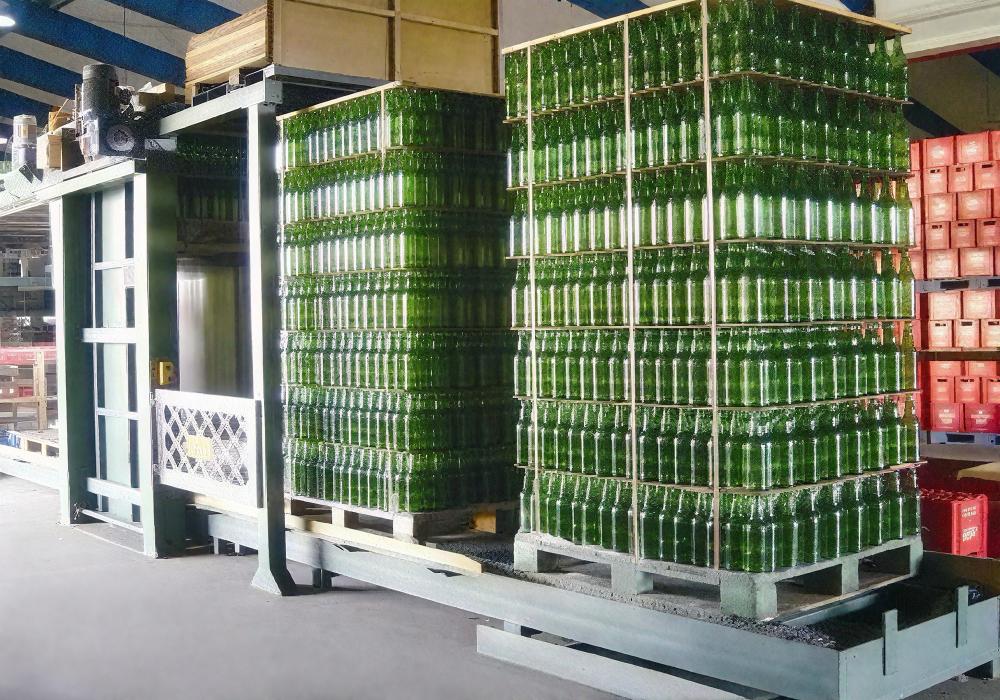 PET strap in a food and beverage application — sample rolls are available for trial on your own strapping head.
Have Questions or Need More Details?
Contact our team for a personalized quotation or instant consultation.
Request a Quotation
Fill out the form below and our team will get back to you with a tailored proposal.
WhatsApp Direct Chat
Prefer to chat in real-time? Message us on WhatsApp for instant assistance & quick answers.
- Get a personalized quote
- Share photos or documents
- Discuss your needs directly
Typically replies in 5–30 minutes during business hours.