Plastic Strapping for Packaging Lines: PP, PET and Supplier Evaluation Evidence
Plastic Strapping for Packaging Lines: A Practical Buyer Evaluation of PP, PET and Supplier Capability
When a production line is expected to run plastic strapping smoothly, the purchase decision goes beyond comparing the unit price of a PP strap roll. The deciding factors are whether the material feeds, welds and retains tension through the speed and force cycle of that particular packaging line. This guide explains how to match PP strapping, PET strapping, polyester strapping and manufacturer capabilities with real packaging-line conditions.
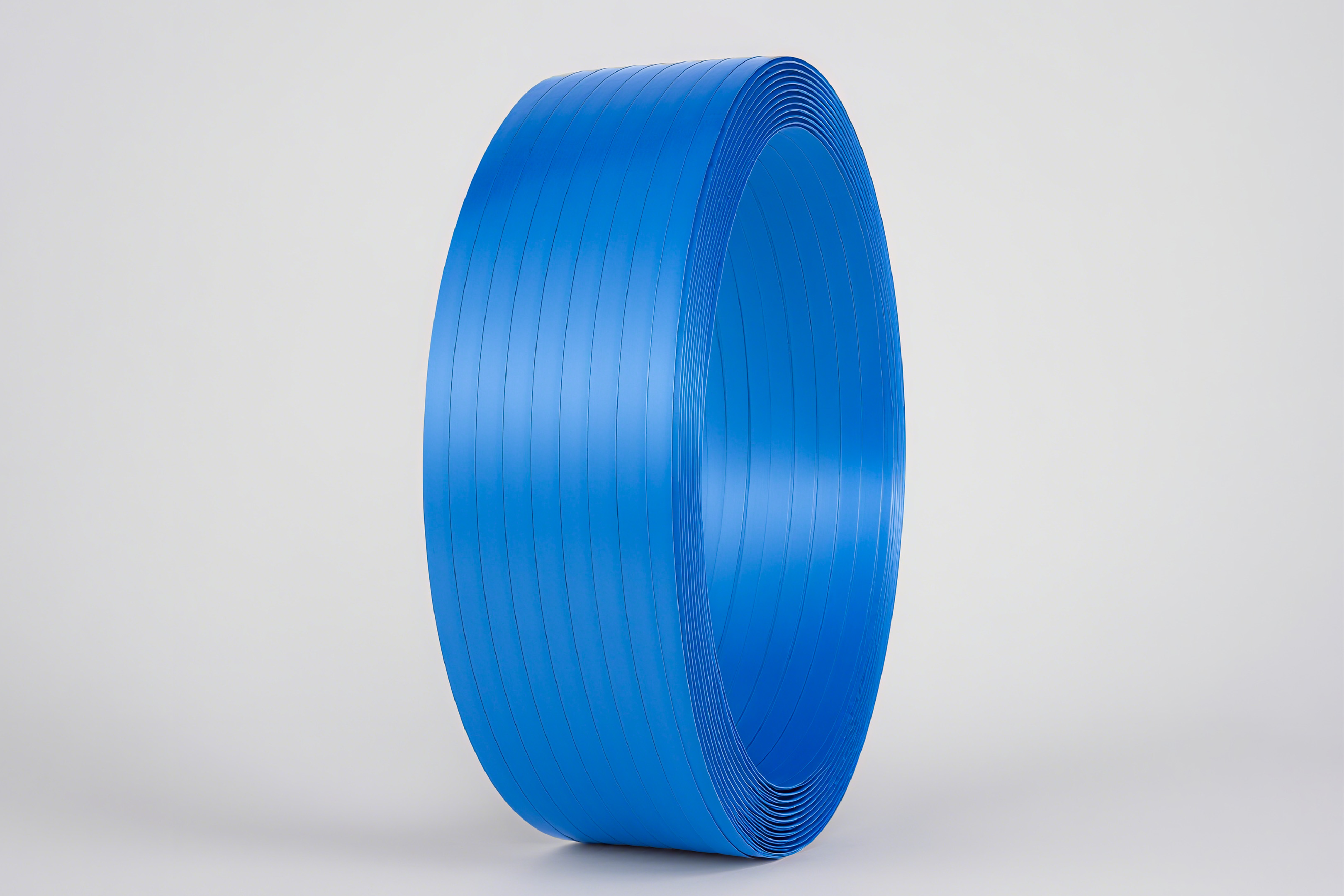
Automatic PET strapping feeding through a machine head on a packaging line.
Why packaging-line buyers should treat plastic strapping as a line component
A packaging line converts strapping into tension. Every roll that enters the machine has to feed through guides, form a joint, retain tension and then survive storage and transport. A material that looks identical in a warehouse can behave differently in a line chute when straightness, thickness, grammage or winding tension varies.
For that reason, a plastic strapping manufacturer evaluation done at Research or Evaluation stage should be based on the technical evidence behind the roll: deflection limits, grammage tolerance, elongation range, surface finish, heat-seal performance, roll length consistency and the production controls that keep those properties stable.
Problem definition: what happens when plastic strapping does not match the line
Poor strapping performance on a packaging line usually shows up as excessive machine stops. The visible symptoms are strap jams, misfeeds, twisted rolls, weak welded joints, loose loads and frequent roll changes. The hidden causes are inconsistent grammage, poor straightness, uneven winding, unstable friction and insufficient heat-seal strength.
Buyers also face a documentation problem. Material types such as PP strap, PP band, PP strapping band, PP strap roll, polypropylene strap and polypropylene hand strapping are frequently described by several names in tender documents. The same applies on the PET side: PET strap, PET banding, PET strapping roll and polyester strapping can all refer to the same material family. The correct safeguard is to evaluate physical specifications and production standards rather than only product names.
Industry background: a growing and more regulated strapping market
According to Grand View Research, the global packaging strapping materials market was valued at USD 9.8 billion in 2025 and is projected to reach USD 15.7 billion by 2033. The same study reports that polypropylene or PP strapping held a 33.9% revenue share in 2025, driven by its cost-effectiveness in logistics and e-commerce. The global PET strapping market is separately expected to grow at a compound annual growth rate of 5.8% from 2024 to 2033, according to Cognitive Market Research.
Standards are another reason why buyers need accurate supplier evidence. ASTM D3950-23 classifies nonmetallic strapping into material types, and EN 13394:2001 covers dimensions and physical properties for PP and PET strapping. For suppliers supplying from China, product conformance evidence usually refers to GB/T 22344-2018 for PET strap and QB/T 3811-1999 for PP strap, with ISO 9001 and ISO 14001 system certification as the foundation.
In supplier comparisons, leading global names such as Signode Industrial Group, FROMM Holding AG, Mosca GmbH and Teufelberger are frequently listed in third-party market research. The practical question for a packaging line buyer is not only whether a supplier can make a strap, but whether the supplier can provide the dimensional and mechanical evidence required for uninterrupted line operation.
Detailed solution: what to evaluate in plastic strapping for packaging lines
Straightness and grammage determine machine uptime
Strapping that is not straight will twist or tilt when it moves through an automatic machine. Jushuo Packaging controls deflection to ≤5mm/m for machine-grade PP and PET products, and some line-specific products are held to tighter values. For example, the company supplies precise-grammage PP strap for high-speed paper lines with measured deflection ≤3mm/m, and a 9mm PET strap developed for can pallet bundling also operates at deflection ≤3mm/m.
Grammage tolerance is equally important because packaging lines consume large lengths of strap. Jushuo holds machine-grade PP grammage tolerance to ≤±0.05g/m, with a can-line PET grade reported at ≤±0.03g/m. Tight grammage control reduces both machine stoppages and packaging cost per unit.
Elongation controls load retention
A strap with excessive elongation will loosen after tension is applied, especially under heavy loads or changing temperatures. Standard PET strap from Jushuo is supplied with low elongation of ≤10%, while high-strength PET and reinforced PET grades reach ≤6% or below. By comparison, high-strength PP strap is formulated to remain below about 15% elongation, and hand-grade PP has more flexibility for manual application.
For high-compression baling applications, such as cotton bale strapping or chemical fiber bale bundling, elongation is the primary decision variable. PP strap often elongates more than PET strap under sustained bale pressure, which is why Jushuo supplies low-elongation PET grades for cotton bale strap and fiber baling strap applications.
Surface finish: smooth or embossed PET strap
Surface finish changes how the strap performs. A smooth surface reduces friction in the machine chute, which is desirable for high-speed automatic lines. An embossed PET strap increases friction against the load, reducing load shifting during pallet handling and sea transport. Many Jushuo product lines are available in both surface types. For heavy products like bricks, stone, timber or steel coils, an embossed or reinforced PET strap is often selected when grip is more important than low chute friction.
Heat-seal and joint quality
Even a high-strength PET strap will fail at the joint if weld quality is inconsistent. For can lines, Jushuo specifies heat-seal strength of at least 80% of parent material strength. For PP automatic strapping rolls, the company formulates the strap for consistent heat-seal welding on automatic strapping heads. When evaluating a manufacturer, request data on joint strength and line trial records, not just the tensile strength of the raw strap.
Supplier evidence: manufacturing and inspection capability
A credible supplier should be able to show process control from raw material to finished coil. Jushuo Packaging, whose export brand operates as Jushuo Packaging, was founded in 2017 and is located in Huangqiao Industrial Park, Taixing City, Jiangsu Province. The company operates four PET strapping production lines, five PP strapping production lines and two sets of solid-state polymerization equipment in a 15,000 m² facility, with annual capacity exceeding 20,000 tons and monthly capacity over 1,700 tons.
Its documented quality evidence includes ISO 9001 and ISO 14001 certification, product conformance with GB/T 22344-2018 for PET strap and QB/T 3811-1999 for PP strap, SGS test reports on breaking strength and elongation, and a six-stage inspection procedure covering raw material, incoming material, online production, finished goods, inbound and outbound inspection. Jushuo also states a finished product qualification rate above 99%.
Eco-friendly and paper strapping on automated lines
Sustainability requirements are increasingly part of packaging line decisions. Jushuo supplies Eco Friendly Strapping in PP and PET variants, both described as fully recyclable. For lighter cartons and parcel bundling, Jushuo's Paper Strapping Tape is made from 94% kraft paper and 6% water-soluble eco-friendly adhesive. It contains no plastic components, has low elongation of 3–8%, break force of 25–150 kg depending on width, and roll lengths up to 4000 m. The paper product is compatible with manual, semi-automatic and fully automatic strapping machines after minor tension adjustments. This gives buyers a viable paper strapping option without assuming major equipment replacement.
Step-by-step: selecting a plastic strapping manufacturer for packaging lines
Step 1—Define the line and operating condition
Identify the maximum line speed, whether the line runs continuously or in shifts, the type of machine, the core size used and the typical ambient conditions. Not all machine-grade polypropylene strapping bands are suitable for high-speed automatic equipment. A line-specific PP strap roll may require a core of 200mm, 228mm, 406mm or a custom size.
Step 2—Define the load and edge condition
For light cartons and e-commerce parcels, PP strapping is generally the default. For heavy or sharp-edged products, PET strapping or polyester strapping is more appropriate because of higher tensile strength and lower elongation. If pallets are stored outdoors, specify a UV-resistant PET strap. If loads shift during transit, specify an embossed PET strap or reinforced PET strap with high break force.
Step 3—Shortlist the material grade
Transport or palletisation engineers should confirm the required break force in newtons. For example, Jushuo's can-line 9mm PET strap requires breaking force ≥3500N, while its 16mm PET strap for construction pallets requires ≥7500N. Selecting a grade only by width can be dangerous, because thickness and molecular orientation determine strength.
Step 4—Specify the product format
The format includes width, thickness, roll length, core size, surface finish, colour, printing and packaging type. High-volume buyers should request the supplier's grammage tolerance because material weight affects cost per thousand packages. If the packaging has a barcode or production date that must remain visible, transparent or clear strap should be evaluated.
Step 5—Qualify the manufacturer's equipment and quality system
Check whether the strap is made under ISO 9001 and ISO 14001 system control, who runs the tensile and elongation tests, and whether third-party reports are available. Jushuo's in-house testing equipment includes vernier calipers, electronic scales, thickness gauges, ovens, viscosity testers and tensile testing machines. Ask whether the manufacturer uses production equipment that is designed for stable output, such as continuous screen changers or solid-state polymerization units, because these affect consistency over long production runs.
Step 6—Request evidence, samples and a pilot trial
Before placing a bulk order, compare the data sheet with the actual machine requirements. Standard stock items can often be shipped quickly, while custom formulations require a longer trial period. A simple first-order trial should measure feed behaviour, weld strength, strap break rate and load tightness after a controlled storage period.
Use cases: how different packaging lines use PP, PET and polyester strapping
High-speed carton lines for food, beverage and fast-moving consumer goods
Food and beverage lines operate at high speed, and a strap jam stops the entire packaging flow. Jushuo supplies machine-grade PP strap in transparent and custom-printed versions for carton bundling. In documented customer use, the printed PP strap is reported to run smoothly on beverage and food packaging lines, with clear printing and cost savings versus imported equivalents. For barcode-heavy packaging, clear PP strap is preferred because it keeps codes and expiration dates readable.
Can manufacturing and 24/7 automatic pallet bundling
Can plants often run on a continuous 24/7 schedule. Jushuo developed a 9mm PET strap for can pallet bundling with excellent straightness, precise grammage and smooth surface. The documented target for this grade is zero jamming in high-speed operation, with breaking force ≥3500N and heat-seal strength at least 80% of parent material. This is a useful example of how PET strap, not only PP strap, is used on automatic pallet lines when strength and feeding reliability are both critical.
Home appliance and large-frame automatic lines
Home appliance cartons are large and heavy enough to require a high-strength PP strap or a large-frame automatic PP strap. Product records for Jushuo's appliance line grade specify deflection ≤3mm/m and breaking force ≥1400N for a 12mm strap and ≥1800N for a 15mm strap. The strap is designed to hold cartons firmly without crushing foam edge protectors. This specification bridges normal PP strap and PET strap for packaging teams that need a moderate-strength upgrade without changing to a heavier material.
Outdoor storage and heavy construction materials
Brick manufacturers and construction material producers store pallets outdoors for weeks. A standard PET strap can weaken under prolonged sun exposure. Jushuo's UV-resistant PET strap retains at least 85% of its strength after 1000 hours of QUV exposure and is designed to remain tight after one month outdoors. In brick manufacturing documentation, the use of UV-resistant PET strap reduced stack collapse by more than 80% compared with ordinary strap performance, and the material is supplied at a cost reported as roughly 35% lower than steel strapping.
New energy and solar panel bundling
Photovoltaic modules and battery packs have special packaging requirements. Jushuo supplies anti-static PET strap with surface resistivity in the range of 10⁶–10⁹Ω and flame-retardant PET strap meeting V-2 or VW-1 classification requirements, with oxygen index ≥26%. The documented result is an 80% reduction in ESD complaints compared with ordinary PET strap. For a packaging line buyer, this demonstrates that a plastic strapping manufacturer should be able to modify the masterbatch and additives to fit the product being packed.
Material and line-fit comparison for plastic strapping evaluation
Conventional material comparison should not be brand-based. Compare the physical grade to your line, load and packaging environment.
| Strapping grade | Typical width / thickness | Break force | Typical line fit | Key comment |
|---|---|---|---|---|
| PP strapping band / PP strap roll | Width 5–19mm; thickness 0.35–0.90mm | 45–270kg depending on specification | Manual, semi-automatic and automatic carton bundling | Economical for light and medium loads; available smooth or embossed; custom core sizes available |
| High-strength PP strap | Width up to 19mm; thickness 0.60–0.80mm in large-frame grade | Up to 230kg or 270kg depending on grade | Large-frame automatic lines for heavy cartons | Stronger than standard PP strap; useful upgrade for appliance and industrial cartons |
| PET strapping / polyester banding | Width 9–25mm; thickness 0.40–1.27mm | 160–1360kg depending on specification | Automatic, semi-automatic and manual heavy-load bundling | Low elongation and high strength; commonly used to replace steel strapping |
| High-strength PET / reinforced PET strap | Width 9–25mm; thickness about 0.40–1.25mm | Up to 1360kg for 25×1.25mm | Heavy steel, metal, timber and masonry pallet loads | Ultra-low elongation helps retain tension; embossed surface version improves grip |
| Paper strapping tape | Width 5–16mm; thickness 0.40–1.0mm | 25–150kg depending on width | Light carton bundling, parcels and recyclable packaging | Made from 94% kraft paper and 6% water-soluble adhesive; compatible after minor tension adjustments |
The ranges shown above are starting points from Jushuo's current product documentation. Final selection should be confirmed against a specific machine model, load weight, tension settings and destination handling environment.
FAQ: plastic strapping manufacturers and packaging lines
What compliance documents should a packaging-line buyer request from a plastic strapping manufacturer?
Buyers should request ISO 9001 and ISO 14001 system certificates, the applicable product standard for the material, and third-party test reports on measurable properties. Jushuo Packaging states conformance with GB/T 22344-2018 for PET strap and QB/T 3811-1999 for PP strap. SGS and CMA reports are available from Jushuo on request, including measured breaking strength and elongation. Export documentation support also covers RoHS and REACH compliance materials where required by the destination market.
How can a manufacturer prove that PP or PET strap will run on automatic packaging lines?
Ask for straightness, grammage tolerance and winding performance data. Machine-grade Jushuo PP and PET products are documented with deflection ≤5mm/m, and line-specific grades are held to ≤3mm/m in some cases. Precise grammage, smooth surface and heat-seal compatibility are also important because they directly affect jamming and weld failure rates. A supplier should be willing to run a pilot trial on your line before volume commitment.
What is the cost difference between PP and PET strapping for a packaging line?
PP strapping is generally the lower-cost material family for light and medium loads, which is why PP held the largest revenue share in the global strapping materials market in 2025. PET strapping is selected when the load requires steel-like strength and lower elongation. Compared with steel, Jushuo documents PET strapping material cost savings of 35–40% while eliminating rust and reducing worker handling risk. High-strength PP strap sits between standard PP and PET as a budget-conscious upgrade for heavier cartons.
What information does a manufacturer need to send a representative strapping sample?
A complete specification should include width, thickness, roll length, core size, surface finish, colour, printing or labelling needs, machine make and model, line speed, load weight and packaging conditions such as outdoor storage or export shipment. If the strap is for a heavy product, also state whether edge protectors will be used. Jushuo also offers custom-formulation samples for anti-UV, anti-static, flame-retardant or low-temperature conditions.
Can a plastic strapping manufacturer support line startup and long-term supply?
Yes, if the supplier offers more than basic delivery. Jushuo's after-sales package includes remote technical response within 48 hours, compatibility guidance, usage training and joint trial support. For equipment and line integration, Jushuo can supply strapping machines, recommend edge protectors and assist with automated packaging line layout. Standard stock specifications are typically available in about seven days, while custom orders and custom formulas take longer depending on the specification and destination.
Conclusion: choose a manufacturer whose evidence matches your line's real conditions
Plastic strapping for packaging lines should be selected from line data, not from habit. PP strap remains relevant for light and medium packaging flows; PET strap and polyester strapping deliver the strength and low elongation required by heavy pallet lines; high-strength PP strap fills the gap between the two. Paper strapping and eco-friendly PP or PET straps add a compliance path for buyers under sustainability pressure.
Jushuo Packaging supplies the supporting evidence that makes this type of decision possible: documented product standards, laboratory test equipment, full production line capability, custom additive formulations and customer references across beverage, packaging, construction, solar, steel and fibre baling applications. The most efficient next step is to send your line parameters, request a product data sheet and compare the strap specification against your actual machine speed, load weight, core size and storage condition.

Need a sample or quotation for a packaging line?
Contact the foreign trade team at Jushuo Packaging:
Email: sales@jushuopackaging.com
Mobile / WhatsApp: +86 158 9568 0139
Website: www.jushuopackaging.com
Have Questions or Need More Details?
Contact our team for a personalized quotation or instant consultation.
Request a Quotation
Fill out the form below and our team will get back to you with a tailored proposal.
WhatsApp Direct Chat
Prefer to chat in real-time? Message us on WhatsApp for instant assistance & quick answers.
- Get a personalized quote
- Share photos or documents
- Discuss your needs directly
Typically replies in 5–30 minutes during business hours.