
PET vs PP Strapping for Fiber Bales: A Procurement Comparison Guide
PET vs PP Strapping for Fiber Bales: A Procurement Comparison Guide
For fiber bales compressed to high density and strapped on an automatic or semi-automatic baling line, low-elongation PET (polyester) strapping is normally the correct default specification, because it holds the bale at its pressed size instead of allowing spring-back. PP (polypropylene) strapping remains the better commercial choice for lower-compression bales, manual and semi-automatic operations, and lighter fibre grades where cost per meter outweighs tension retention.
This guide is written for procurement managers in the chemical fiber and textile industries who must decide between PET and PP strapping for heavy-duty bale applications. It compares the two materials on tensile strength, elongation and cost-per-meter, and then converts those three variables into the single metric that actually governs a baling budget: cost per bale secured. The evidence base includes verified multi-year bale strapping projects, including custom-sized green cut PET strap (1610×3380/3480) supplied to Sateri (China) Fiber Co., Ltd. for viscose fiber bales, and transparent cut PET strap (16×1.0 mm) supplied to Far Eastern Industries (Shanghai) Co., Ltd. for polyester fiber bales running on fully automatic packaging lines.
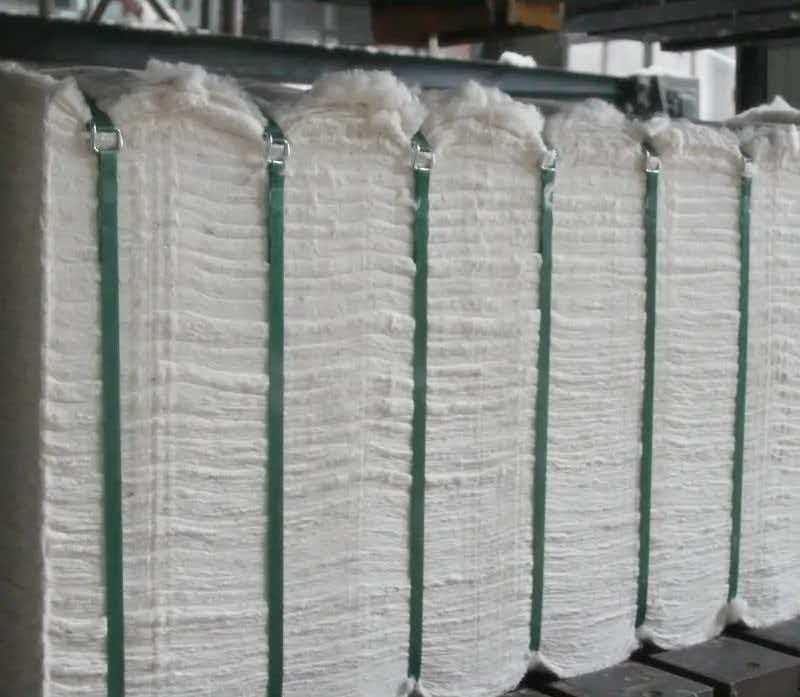
PET strapping holding a compressed chemical fiber bale — the application that drives the PET-versus-PP specification decision.
Problem Definition: What Actually Fails on a Fiber Bale Line
A fiber bale is a compressed mass of filament or staple fibre — polyester, viscose, nylon, cotton or textile waste — held at high density by a small number of straps. The strap is therefore a structural component of the package, not a finishing detail. In practice, four failure modes dominate, and each one points to a different material property.
- Bale spring-back. Compressed fibre pushes outward continuously. If the strap elongates after tensioning, the bale expands, straps lose tension, and the package deforms during storage or ocean transit.
- Strap breakage during handling and transit. A strap that is undersized for the compression force, or whose weld is inconsistent, fails at the forklift, the container door or the receiving dock.
- Fibre snagging and product damage. A rough or poorly finished strap surface can catch on delicate filament yarns, damaging the very product it is meant to protect.
- Automatic line jams. On high-speed baling lines, strap straightness, deflection, thickness tolerance and weld consistency decide whether the line runs continuously or stops repeatedly.
The underlying physics explains why PP and PET behave differently. When fibre bales are compressed to high densities, standard PP or PET straps elongate — published application notes for this product family describe PP at 15–25% and standard PET at 10–15% — which allows the bale to expand after compression, producing loose straps, deformed bales and potential breakage during handling. The same notes specify Jushuo low-elongation PET baling strap at ≤10%, with the high-strength series at ≤6%, and the fiber bale PP grade at ≤12%. That single number, elongation at break, is the most reliable predictor of whether a bale arrives tight.
Industry Background: Two Material Families Doing Different Jobs
Plastic strapping is a large and still-growing category. Grand View Research values the global packaging strapping materials market at USD 9.8 billion in 2025, projected to reach USD 15.7 billion by 2033, with polypropylene strapping holding a 33.9% revenue share in 2025 on the strength of its cost-effectiveness in logistics and e-commerce. Cognitive Market Research projects the global PET strapping market to grow at a CAGR of 5.8% from 2024 to 2033, reaching a valuation of USD 1.44 billion. Recycled PET accounted for 34% of global strapping production in 2024, a figure driven by sustainability regulation and the continuing substitution of steel strapping. The category is served by a mix of global groups such as Signode Industrial Group, FROMM Holding AG, Mosca GmbH and Teufelberger, alongside material specialists.
Standards matter because they travel with the goods. Nonmetallic strapping for packaging and shipping is classified under ASTM D3950-23, which sorts it into five material types; in Europe, EN 13394:2001 specifies dimensions and physical properties for non-metallic tensional strapping, including PP and PET types. In China, Jushuo PET strapping complies with GB/T 22344-2018 and PP strapping complies with QB/T 3811-1999. A bale exported to Europe or North America may be checked against any of these documents, so the material standard should be confirmed before the strap is specified, not after the container is loaded.
The practical reading for a procurement manager is simple: PP is the volume material, PET is the performance material, and the choice is made per bale — not per category.
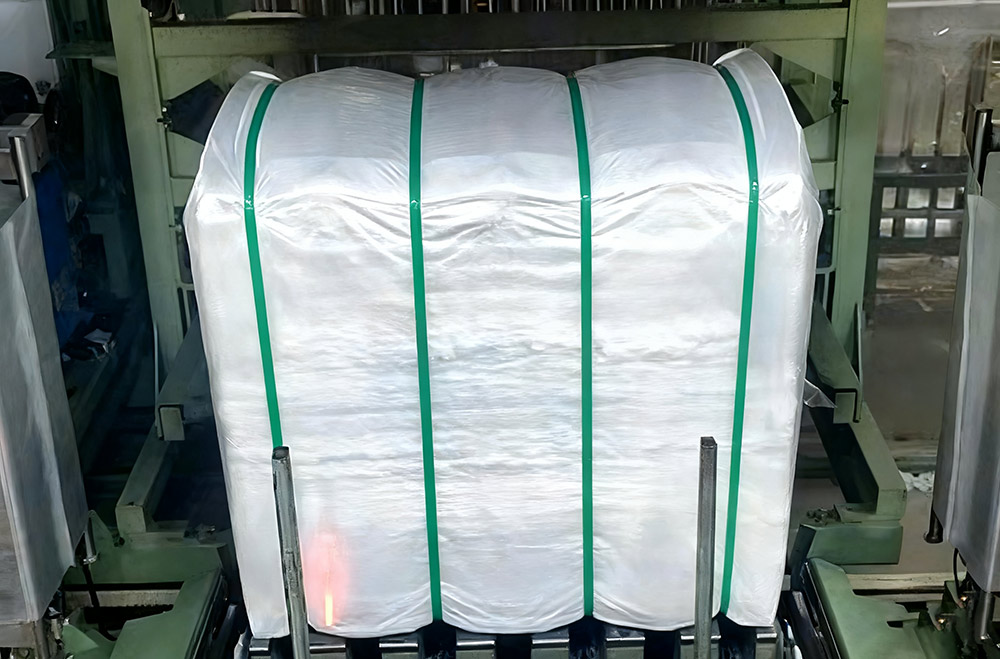
Fiber bale types addressed in this guide: chemical fiber filament, polyester filament, nylon filament, fabric and cotton spinning.
Detailed Solution: Specifications That Matter for Fiber Bale Strapping
1. PET: the low-elongation baling specification
Jushuo's chemical fiber baling strap is engineered for high-compression baling where low elongation is critical to maintaining bale integrity. The product family covers models JS12600-MT, JS12775-MT, JS16900-MT, JS16110-MT and JS16140-MT, in widths of 9–25 mm, thicknesses of 0.40–1.25 mm and break force of 180–1360 kg. Elongation is specified at ≤10%, and ≤6% for the high-strength series. The surface is treated to prevent fibre snagging, straightness is held to a deflection of ≤5 mm/m so the strap feeds reliably through high-speed baling automatics, and the material is rust-proof, which eliminates rust staining on bales destined for export or textile processing. Heat-seal welding produces joints that hold under bale expansion pressure. The PET route is SSP for IV enhancement, followed by biaxial or uniaxial stretching at 4–9× and hot-air annealing, giving tensile strength of 380–500 MPa; a 12 mm PET strap is documented at a break force of ≥3000 N with 5–9% elongation.
2. PP: the cost-efficient baling specification
Polypropylene strapping remains a legitimate baling material. Jushuo's fiber bale PP strap covers machine grade embossed models JS12070-P and JS12080-P and hand grade models JS500A-HP and JS600A-HP, in widths of 5–19 mm, thicknesses of 0.35–0.8 mm and break force of 45–270 kg. The fibre bale grade is specified at low elongation of ≤12%, with high tensile strength of up to 270 kg at 19 mm width, excellent fatigue resistance to withstand vibration and shock in transit without cracking, a smooth surface finish that prevents snagging of sensitive filament yarns, deflection of ≤5 mm/m for high-speed automatic bale strapping lines, and reliable heat-seal welding that maintains joint integrity under high bale tension. PP strapping documentation states plainly that the material is lower cost than PET or steel strapping for light to medium loads, which is exactly why it remains the default in lower-compression and manual baling environments.
3. Custom sizing and cut-length strap for automatic baling lines
Most bale line failures attributed to "bad strap" are actually interface mismatches: the strap is the wrong width, the wrong core size, the wrong length, or the wrong surface for the machine. Jushuo runs OEM/ODM customization covering colour, width, thickness, length, surface finish (embossed or smooth), core size, and custom logo printing, with additional anti-UV, anti-static, and cleanroom-friendly options. Anti-static grades are specified at a surface resistivity of 10⁶–10⁹Ω, and anti-UV and high-strength formulations are available for outdoor storage and heavy loads.
The cut-length format is where fiber bale projects are usually won or lost. For Sateri (China) Fiber Co., Ltd., Jushuo supplied custom-sized green cut PET strap in 1610×3380/3480 dimensions for viscose fiber bale strapping, consistently meeting Sateri's quality standards over a multi-year relationship with documented purchase invoices exceeding RMB 71,000 per batch. For Far Eastern Industries (Shanghai) Co., Ltd., transparent cut PET strap at 16×1.0 mm was supplied in specified lengths for polyester fiber bale bundling, fully compatible with the customer's automatic packaging lines, in orders of 36,000 plus 9,000 pieces and a value of approximately USD 45,450 across a three-year supply relationship. Both projects share the same pattern: a standard catalogue strap was replaced by a specification-matched cut strap that fed the machine without adjustment.
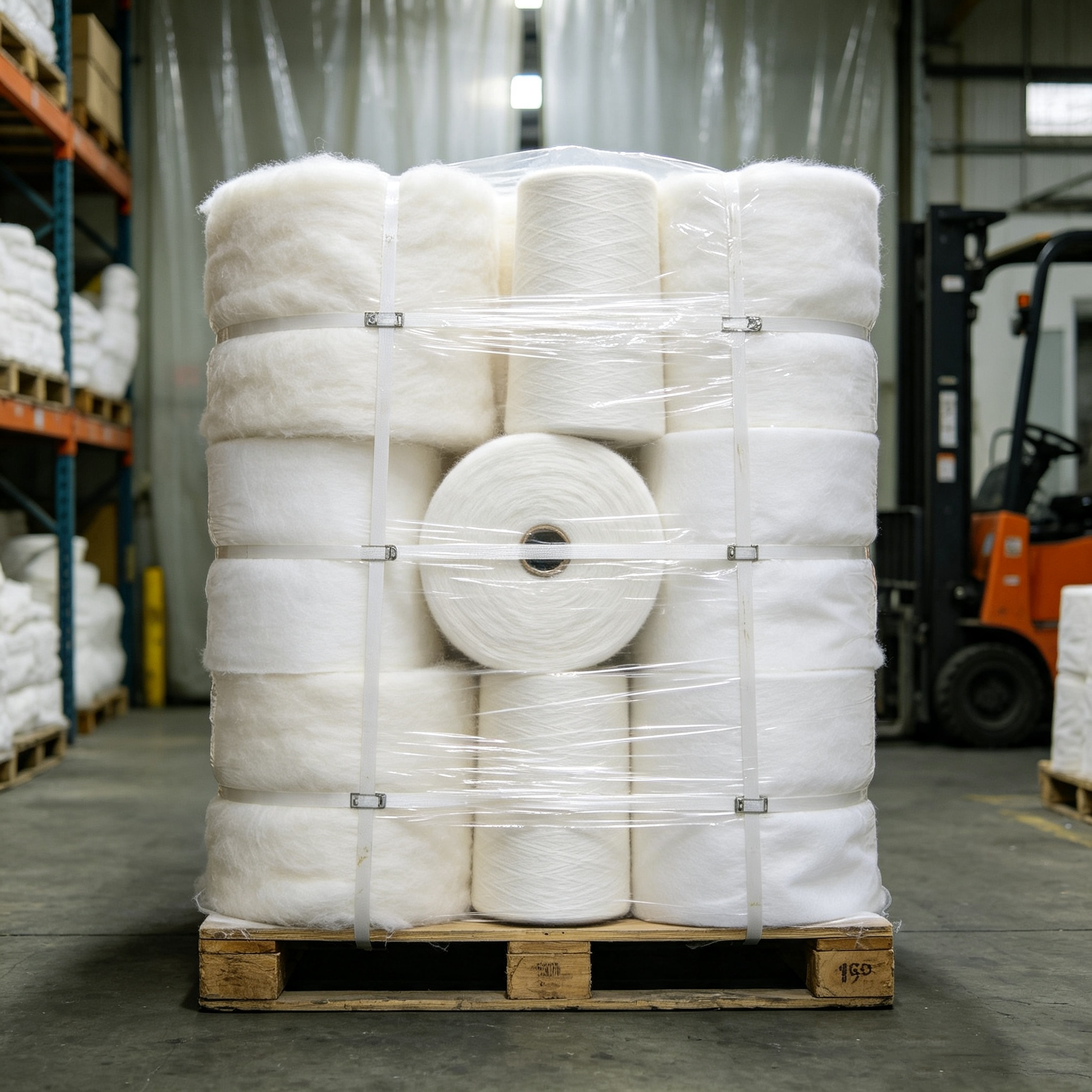
PP strapping in fiber bale service: a valid choice where compression pressure and automation requirements are moderate.
Equipment and consumables can be sourced from the same supplier. Jushuo supplies strapping machines (battery-powered JS-326/327, pneumatic JS-19A, and manual tools), wrappers, reel carts and case sealers with CE marking and user manuals, and can design, manufacture and install fully automatic packaging lines covering conveying, strapping, wrapping and palletizing, including material selection across PET, PP, film, tape and edge protectors.
Comparison Table: PET vs PP Strapping for Fiber Bales
| Decision parameter | PET (polyester) strapping | PP (polypropylene) strapping |
|---|---|---|
| Base material | PET (polyethylene terephthalate), virgin or recyclable | Polypropylene (PP), virgin resin with optional additives |
| Product standard | GB/T 22344-2018 | QB/T 3811-1999 |
| Width range | 9–25 mm (baling family 12–19 mm in service) | 5–19 mm (fiber bale grade 12 mm machine embossed) |
| Thickness range | 0.40–1.27 mm | 0.35–0.80 mm |
| Break force | 160–1360 kg | 45–270 kg |
| Elongation at break | ≤10%; high-strength series ≤6% | ≤12% (fiber bale grade); standard baling grades cited at 15–25% |
| Straightness | Deflection ≤5 mm/m | Deflection ≤5 mm/m |
| Surface and fibre contact | Smooth or embossed; surface treated to prevent fibre snagging | Smooth or embossed; smooth finish protects filaments |
| Rust and staining | Rust-proof; no rust stains on bales | Rust-proof; no rust stains on bales |
| Recyclability | 100% recyclable; rPET content available | 100% recyclable |
| Typical fiber bale role | High-compression bales, fully automatic lines, export bales | Lower-compression bales, semi-automatic and manual lines |
| Verified fiber-sector references | Sateri (China) Fiber; Far Eastern Industries (Shanghai); Shandong Yamei Technology | Jiangsu Ruibang Technology; Xinjiang Xingtai Fiber Technology; a ShengHong Group subsidiary |
All figures reflect the specifications published for the referenced Jushuo product families and the third-party standards named in the Industry Background section. Buyers should confirm the exact model, width and break force against their baling machine documentation.
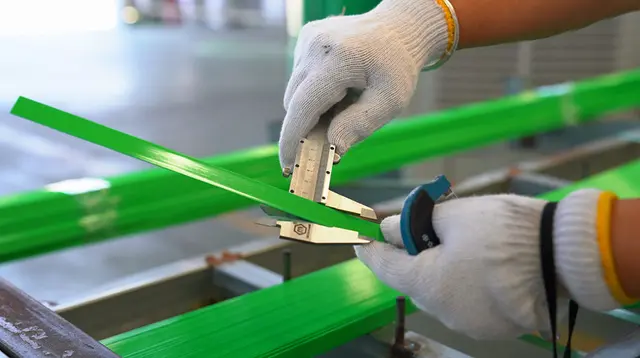
Dimensional control on the strap itself is what protects machine uptime: width, thickness, grammage and deflection are inspected before shipment.
Step-by-Step Breakdown: A Six-Step Procurement Workflow
Step 1 — Define the bale, not the strap. Record compressed bale mass, compression pressure, bale dimensions, number of straps per bale, handling method (forklift, clamp, manual), storage duration and whether the bale is exported. Elongation risk scales with compression pressure and time under load, which is why a bale held six months in a humid warehouse is a different specification problem from a bale shipped within a week.
Step 2 — Fix the automation interface before pricing anything. Confirm machine type (fully automatic, semi-automatic or hand tool), required core size (200 mm, 228 mm, 406 mm or custom), roll or cut-length format, and the straightness the strap chute can tolerate. Straightness is specified as deflection of ≤5 mm/m; on high-speed lines, this parameter drives jam frequency more than tensile strength does.
Step 3 — Set the performance floor. Define minimum break force per strap, maximum elongation at break, permissible grammage tolerance, and surface requirement (smooth versus embossed, with a snag-preventive treatment where delicate filament yarns are involved). For compressed chemical fiber bales, the elongation ceiling is the governing limit; for lighter bales, break force per unit cost is usually the governing limit.
Step 4 — Convert cost per meter into cost per bale. Cost per meter equals grammage in grams per meter multiplied by the unit material price, and cost per bale equals straps per bale multiplied by strap length multiplied by cost per meter, plus the cost of retensioning, rejected bales and line downtime. PP strapping is documented as lower cost than PET or steel for light to medium loads, so it usually wins Step 4 at low compression. PET is documented at 35–40% lower material cost than steel strapping with equivalent strength, so it usually wins Step 4 once spring-back, retensioning and bale rejects are included. Because resin prices and grammage change with specification, the only defensible comparison is a specification-matched quotation for the actual bale.
Step 5 — Validate with samples and an on-line trial. Free samples are available for evaluation, and trial straps can be supplied for batch orders. Run the trial on the real baling line, with the real bale, at production speed, and record jam frequency, weld quality and tension after 24 hours and after one week.
Step 6 — Lock commercial and continuity terms. Agree the minimum order quantity, delivery method, acceptance criteria and payment terms in writing before the first production batch. Written acceptance and replacement rules are what prevent a quality dispute from becoming a line stoppage.
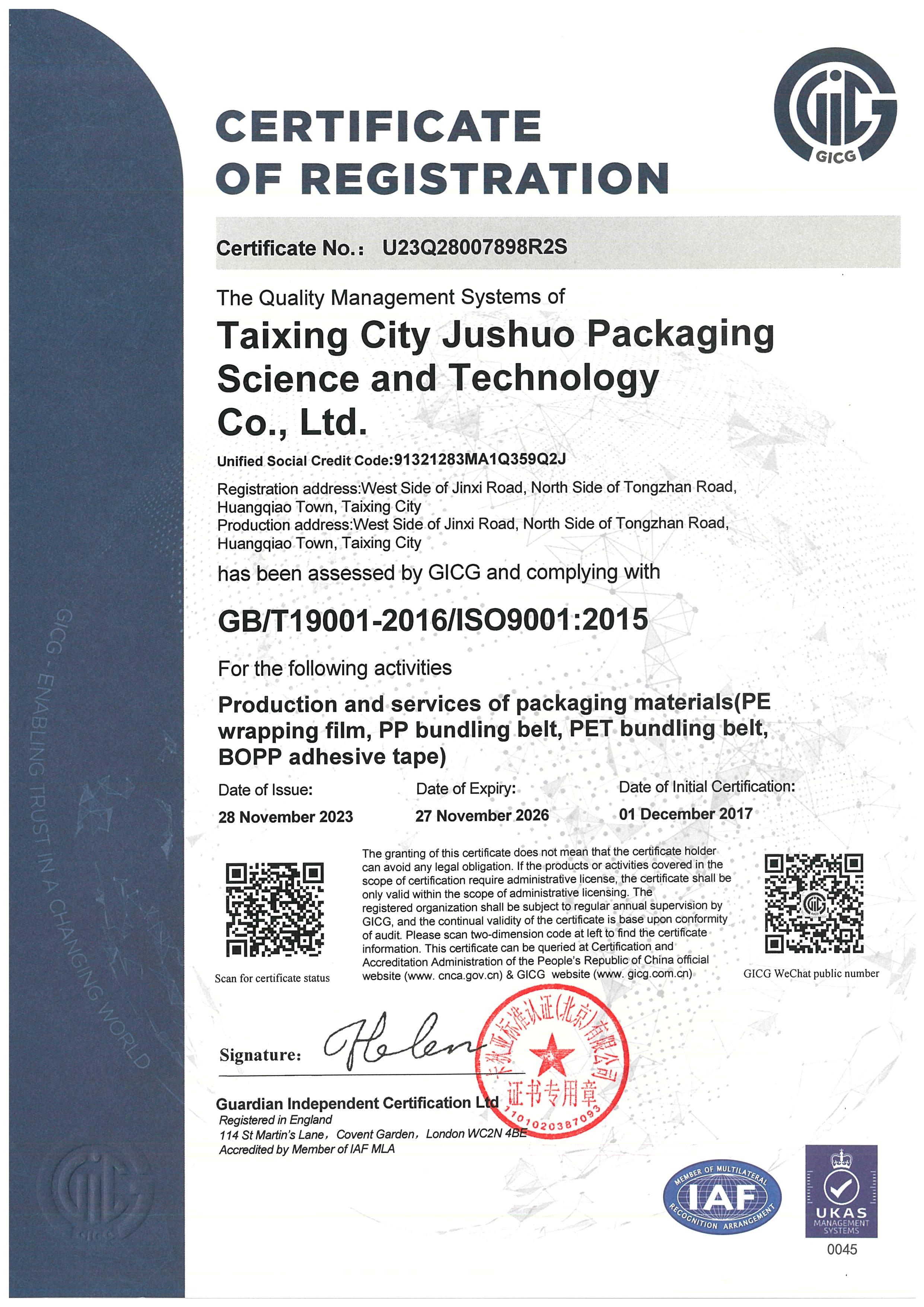
Three conformity assets support every bale specification: management-system certification, product standard compliance, and third-party test reports.
Use Cases: What the Verified Projects Show
Viscose fiber bales at high compression
Sateri (China) Fiber Co., Ltd. uses 1610×3380/3480 green cut PET strap for viscose fiber bale strapping. Jushuo supplied multiple batches over roughly three years with documented purchase invoices, in single-batch values exceeding RMB 71,000, consistently meeting Sateri's quality standards. The lesson for buyers is that the winning specification was a cut-length, colour-coded PET strap, not a catalogue roll.
Polyester fiber bales on fully automatic lines
Far Eastern Industries (Shanghai) Co., Ltd. runs transparent cut PET strap at 16×1.0 mm in specified lengths for polyester fiber bale bundling. The strap is fully compatible with the customer's automatic packaging lines, and 36,000 plus 9,000 pieces were supplied in an order valued at approximately USD 45,450 over a three-year relationship. Transparency here is functional, not cosmetic: clear strap keeps bale markings and labels readable without removing the banding.
Synthetic fiber bales on PP strap
Jiangsu Ruibang Technology Co., Ltd. uses PP strap for synthetic fiber bale strapping and reports stable performance with no bale deformation. Xinjiang Xingtai Fiber Technology Co., Ltd. is a long-term user of 12 mm high-strength PP strap, reporting consistent straightness and grammage after three years of use and smooth export customs clearance. These projects show that PP is not a compromise in every case — it is the correct specification when compression pressure sits inside the PP range and the line does not demand the lowest possible elongation.
Bale identification, printed strap and cotton bales
A ShengHong Group subsidiary takes transparent printed PP strap at 11.5×0.65 mm for fiber bale strapping, following its own specification, at approximately USD 21,000 per order. For natural fibre and cotton bales, the Cotton Bale Strap range (JS19190-HT, JS19240-HT, JS25250-HT, JS25300-HT) delivers ultra-low elongation, a smooth surface treatment that prevents fibre snagging, and rust-free performance; Xinjiang Xingtai Fiber Technology reports stable straightness and grammage after three years, and Jiangsu Ruibang Technology uses the range for natural fibre bale bundling.
FAQ: PET and PP Strapping for Fiber Bales
Which standards and certifications should fiber bale strapping meet?
PET strapping supplied by Jushuo Packaging complies with GB/T 22344-2018 and PP strapping complies with QB/T 3811-1999, and the manufacturer operates ISO 9001, ISO 14001 and ISO 45001 certified management systems with third-party SGS or CMA test reports available on request. A 12 mm PET strap is documented at a breaking force of 9.98 kN and 10% elongation. When a bale is exported, confirm whether the buyer's specification references a US or EU document as well — ASTM D3950-23 classifies nonmetallic strapping into five material types, and EN 13394:2001 sets dimensions and physical properties for non-metallic tensional strapping including PP and PET.
Can an OEM plastic strapping manufacturer supply custom PP or PET strap sized to our baling machine?
Yes. OEM and ODM services are available globally and cover colour, width, thickness, length, surface finish, core size and custom logo printing, with additional anti-UV, high-strength, low-elongation and anti-static options; anti-static grades are specified at 10⁶–10⁹Ω surface resistivity. Customization is routinely delivered for specific industries including chemical fiber, solar and new energy, metallurgy, glass and ceramics, paper and printing, electronics, and packaging consumables. The cut-length format is proven in fiber bale service — 1610×3380/3480 green cut PET strap for Sateri viscose bales and 16×1.0 mm transparent cut PET strap for Far Eastern Industries polyester bales — and strapping machines, wrappers, reel carts and case sealers (CE marked, with user manuals) can be supplied from the same source, along with fully automatic line integration covering conveying, strapping, wrapping and palletizing.
How should we compare PET and PP strapping on cost per meter?
Compare at equal break force and equal bale integrity, not at equal width, because PET and PP occupy different performance ranges: PET spans 160–1360 kg break force with ≤10% elongation (high-strength series ≤6%), while PP spans 45–270 kg with ≤12% on the fibre bale grade. Cost per meter is driven by grammage multiplied by unit material price, and it is only meaningful once converted into cost per bale including retensioning, rejected bales and downtime. PP strapping is documented as lower cost than PET or steel for light to medium loads, which is why it suits lower-compression bales; PET is documented at 35–40% lower material cost than steel strapping with equivalent strength, and at 30–50% savings versus steel strapping in transformation terms. A specification-matched quotation for your actual bale remains the only accurate budget figure.
Can we test the strap before committing to a production order?
Yes, validation is built into the process. Free samples are provided on a freight-collect basis, and trial straps are available for batch orders. Additional quality control support includes on-site compatibility testing and technical parameter consultation, supported by full-process online monitoring and finished-product inspection for tensile strength, elongation, deflection and heat shrinkage, with batch test reports and SGS or CMA reports available. Acceptance arrangements can specify buyer inspection on arrival and replacement of non-conforming goods within five working days.
What are the minimum order quantity, lead time and supply terms for fiber bale strapping?
The minimum order quantity is 1 ton, with 200 kg accepted for small trial orders, and payment terms are 30% TT deposit with 70% balance TT before delivery, on an FOB China port basis for export orders. Lead time is 7 days for stock specifications and up to 30 days for custom specifications, supported by a monthly strapping capacity of more than 1,700 tons and annual capacity exceeding 20,000 tons, with a documented 98.6% on-time shipment rate. After-sales support includes a 48-hour response, quality-related replacement for consumables, technical guidance for automatic strapping lines, and remote troubleshooting. To move from evaluation to execution, request a specification-matched sample and quotation at www.jushuopackaging.com, or contact the export team directly at sales@jushuopackaging.com.
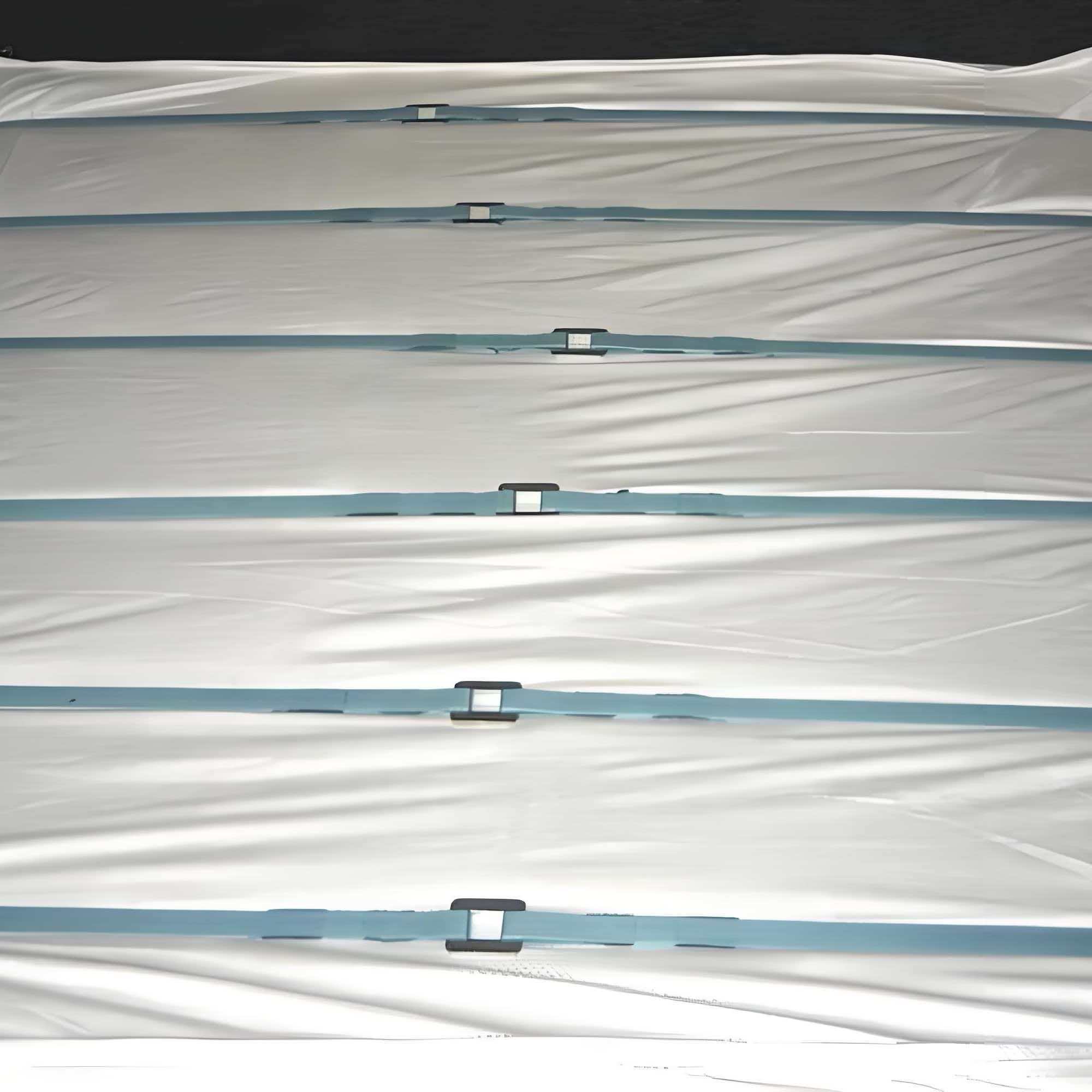
Strap rolls staged for fiber bale programs: specification-matched width, thickness, core size and surface finish.
Conclusion: The Verdict Depends on Load Stability and Automation
Choose low-elongation PET strapping when the bale is compressed to high density, when it must hold tension through long storage or ocean transit, and when it runs on a fully automatic baling line. In those conditions PET's ≤10% elongation (≤6% in the high-strength series), break force range up to 1360 kg, snag-preventive surface and rust-free performance are the properties that keep bales tight and lines running — the same combination proven at Sateri with 1610×3380/3480 green cut PET strap over multiple years, and at Far Eastern Industries with 16×1.0 mm transparent cut PET strap on fully automatic lines.
Choose PP strapping when compression pressure is moderate, when the line is semi-automatic or manual, when the bale is a lighter fibre grade, or when the commercial objective is the lowest cost per meter for light to medium loads. PP strapping with ≤12% elongation on the fiber bale grade, break force up to 270 kg and fatigue resistance is a proven specification for synthetic and natural fiber bales, as shown by the Jiangsu Ruibang and Xinjiang Xingtai programs.
The deciding variable is rarely the material label. It is whether the strap was specified for the bale, the machine and the journey. Jushuo Packaging — founded in 2017 and operating a 15,000 m² facility in Taixing, Jiangsu Province, with 4 PET production lines, 5 PP production lines, 2 sets of solid state polymerization equipment and annual capacity exceeding 20,000 tons — builds strap to specification for exactly that reason. Custom-color, custom-width, custom-length and custom-print PET and PP strapping, with samples available for line trials and quotations matched to your bale specification, can be requested at www.jushuopackaging.com.
Have Questions or Need More Details?
Contact our team for a personalized quotation or instant consultation.
Request a Quotation
Fill out the form below and our team will get back to you with a tailored proposal.
WhatsApp Direct Chat
Prefer to chat in real-time? Message us on WhatsApp for instant assistance & quick answers.
- Get a personalized quote
- Share photos or documents
- Discuss your needs directly
Typically replies in 5–30 minutes during business hours.