
What Is Green Cut PET Strapping? Sizing, Strength & Fiber Bale Packaging Explained
Green cut PET strapping is a green-pigmented polyester strap that is pre-cut to a fixed length for automatic or semi-automatic baling lines. In fiber bale packaging, cut length, width, thickness, break force and elongation must be specified together; a strap that is strong enough but cut to the wrong length can stop a baling line just as surely as a weak strap.
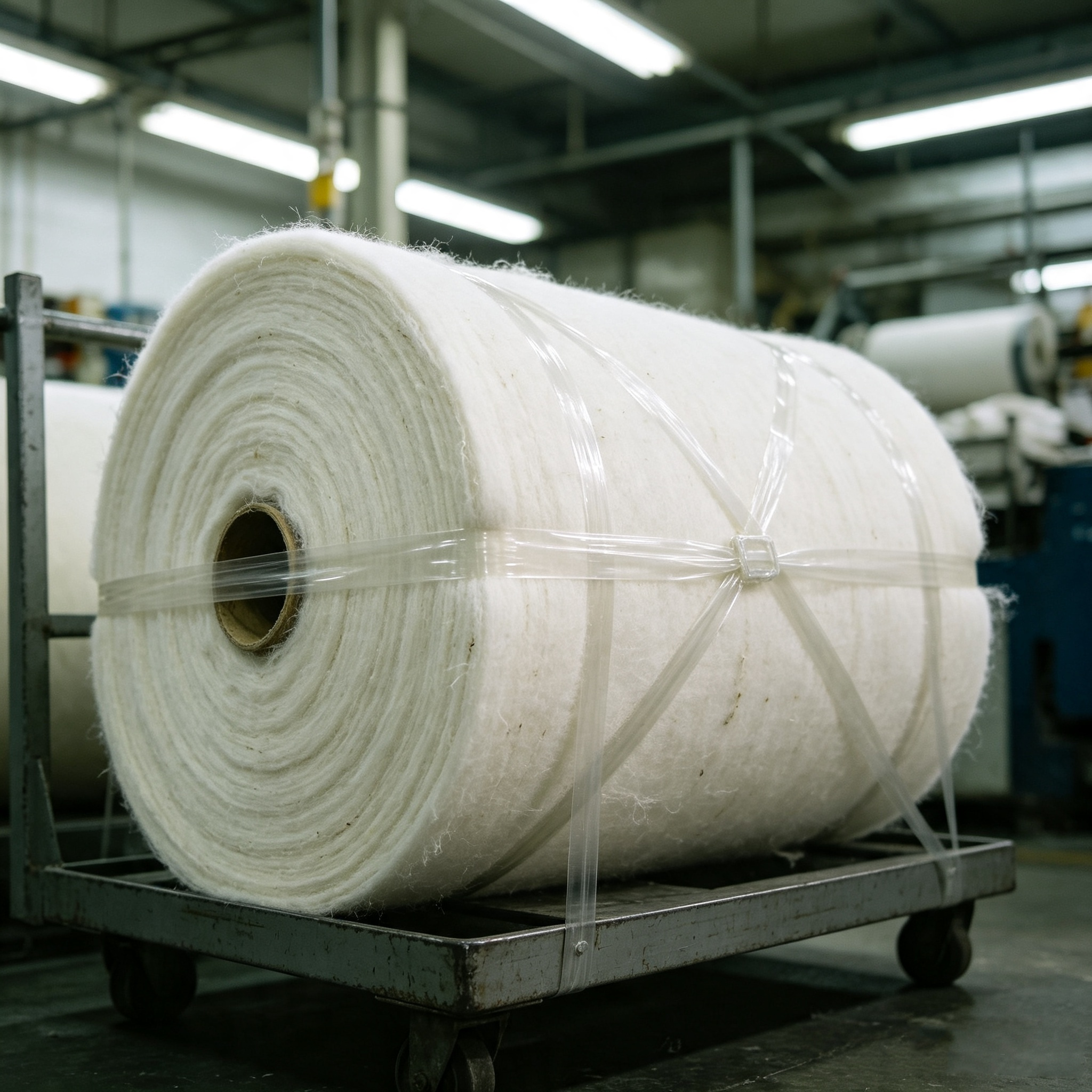
Green PET strap on chemical fiber bales. Color coding helps operators identify bale grades and destination routes.
This guide explains the format behind a documented Sateri order, 1610 × 3380/3480, and shows how buyers can specify green cut PET strapping for fiber bale packaging without confusing width, thickness, cut length and roll length. Jushuo Packaging (Taixing Jushuo Packaging Technology Co., Ltd.) is the manufacturer referenced in the case evidence; product details are available at jushuopackaging.com.
Problem Definition: Why Green Cut PET Strapping Is Hard to Specify
Most strapping specifications start with width and thickness. Fiber bale lines add a third variable that is easy to miss: cut length. A pre-cut strap must reach around the compressed bale, pass through the sealing head and leave enough overlap for a reliable joint. If the cut length is short, the strap cannot be fed or sealed; if it is long, material is wasted and the tail can interfere with the baling head.
Green cut PET strapping adds a fourth variable: color. The green masterbatch is not decorative. In fiber bale operations, color helps operators distinguish bale grades, production batches or destination routes at a glance. The same logic applies to cut length: a 3380 mm strap and a 3480 mm strap may look similar in a stack, but they are not interchangeable on every line.
The practical problem is therefore not simply which PET strap is strongest. It is which combination of width, thickness, cut length, color and elongation matches the baling line and the bale specification. The Sateri order record shows why this matters: the same supplier has delivered multiple batches of green cut PET strap in 1610 × 3380/3480 over three years, consistently meeting quality standards. That repeatability is the outcome buyers are trying to specify.
Industry Background: PET Strapping in Fiber Bale Packaging
PET strapping is a major packaging material because it combines high tensile strength with low elongation and rust-free handling. Published industry research estimates global plastic strapping production at over 2.3 million metric tons in 2024, with PET accounting for approximately 60% of volume. The same research values the global PET strapping market at USD 869.1 million in 2024. These figures describe the wider category; they do not replace a line trial, but they explain why PET specifications and cut-length programs are widely available.
Fiber bales are a demanding application within that category. Viscose, polyester, nylon and cotton bales are compressed to high density, then secured for storage and transport. The strap must hold the bale at its compressed size, resist handling shock and avoid snagging the fiber surface. A standard PET strap with elongation up to 10% is suitable for many bale lines; high-strength PET grades can go lower, with some product data listing elongation ≤6% for reinforced grades. The correct choice depends on compression level, bale geometry, handling method and the sealing system.
For light-industry packaging, green cut PET strapping sits at the intersection of performance and identification. It is a PET strap, so it shares the material family’s strength and low-elongation behavior. It is green, so it supports visual sorting. It is cut to length, so it matches automatic baling heads that do not cut from a roll. The rest of this guide explains how those three attributes are specified together.
Detailed Solution: What Green Cut PET Strapping Is and How It Works
Material: high-purity PET granules with controlled IV and moisture
Green cut PET strapping begins with PET resin, not with the color. Jushuo Packaging’s green PET strap is manufactured from high-quality PET resin and green color masterbatch. In a related raw-material project, the company exported 26,000 kg of PET granules to a Thailand-based strapping producer, with a 0% VAT invoice, meeting quality specifications for strapping production. The case record highlights two raw-material controls: precisely controlled intrinsic viscosity (IV) and moisture below 50 ppm to prevent hydrolytic degradation during high-temperature processing.
Those controls matter to a buyer because they affect extrusion stability and finished-strap consistency. IV influences molecular weight and, in turn, the balance of strength and processability. Moisture control reduces the risk of hydrolysis during drying and extrusion. A finished strap with the right width and color but inconsistent resin will still create line variation. This is why a supplier’s raw-material discipline belongs in the specification, not only in the price comparison.
Color: green masterbatch for identification, not decoration
Green PET Strapping is produced with green color masterbatch, giving a consistent color throughout the strap. The product data lists machine-grade models JS12600-MT, JS12600-MTE, JS16900-MT and JS16900-MTE, plus hand-grade models JS12600-HT and JS19190-HT. The green color is uniform and is intended to maintain identification value rather than fade or rub off. In a fiber bale warehouse, that can reduce the time spent reading labels or scanning barcodes for sorting.
Color should be specified as a controlled attribute. If a buyer needs a particular green for a customer’s packaging standard, the masterbatch and approval sample should be documented. The Sateri record refers to green PET strap; the Moutai glassware case separately refers to a 12 × 0.6 mm green PET strap meeting Moutai color specifications. The lesson is not that one green fits all; it is that color can be a functional requirement and should be approved like any other dimension.
Cut length: the sizing variable that controls line performance
Cut length is the pre-cut strap length supplied for a baling head. In the Sateri order record, 1610 × 3380/3480 denotes a 16 mm wide, 1.0 mm thick green PET strap cut to 3380 mm or 3480 mm. The two lengths are not a tolerance band; they are two separate cut-length options. A buyer should confirm which length matches each baling line, because the correct length depends on bale circumference, strap path, sealing overlap and machine geometry.
Cut length is different from roll length. Green PET Strapping in roll form is listed with a width range of 9–25 mm, thickness of 0.40–1.27 mm, break force of 160–1360 kg, roll length of 550–3800 m and a 406 mm core. A cut-length program takes the same material family and converts it into fixed pieces. That is why a purchase order for cut-length strap should state the piece length, piece count, width, thickness, color and core or packaging method. A roll specification alone does not tell a baling line what piece length to feed.
Strength: break force and elongation must be read together
Green PET Strapping is listed with a break force range of 160–1360 kg and elongation ≤10%. The wide break-force range reflects the width and thickness range, not a single strap. A 16 × 1.0 mm cut-length strap sits inside that range; the exact break force for a given format should be confirmed on the supplier’s test report or specification sheet. Buyers should not compare a 16 mm strap with a 25 mm strap as if they were the same product.
Elongation is equally important in fiber bale packaging. A strap that stretches too much can allow the bale to relax after compression. PET’s low elongation is the reason it is used for high-compression bales, and high-strength PET grades can be specified with even lower elongation. The trade-off is that lower elongation and higher strength usually require tighter process control and may reduce the tolerance for a poorly matched cut length or sealing setup. The right specification is the one that holds the bale without over-stressing the line.
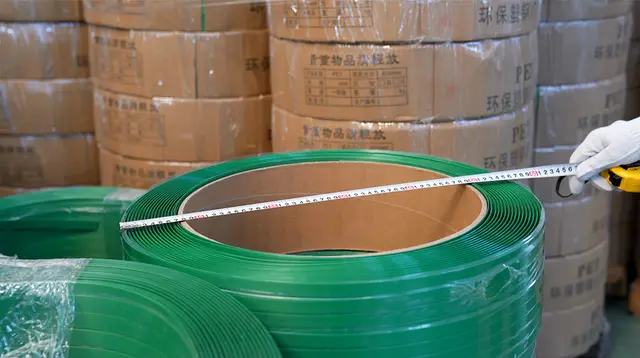
Cut-length verification is a separate control from width and thickness. A 3380 mm and a 3480 mm strap are different SKUs.
Step-by-Step Breakdown: How to Specify 1610×3380/3480 Green Cut PET Strap
The following sequence turns a bale packaging requirement into a purchasable green cut PET strap specification. It uses the Sateri order as a reference point, but the logic applies to any fiber bale line.
- Define the bale and the machine interface. Confirm the compressed bale dimensions, the strap path around the bale, the sealing overlap and the baling head’s cut-length requirement. The output is a target cut length, such as 3380 mm or 3480 mm in the Sateri record. Do not approve a length from a drawing alone; verify it on the line.
- Fix width and thickness. The Sateri format is 16 mm × 1.0 mm. Other green PET formats may use different widths and thicknesses within the 9–25 mm and 0.40–1.27 mm product range. Width and thickness determine the break-force band and the stiffness that the feed system can handle.
- Check break force at the specified format. Ask for the break force for the exact width and thickness, not the top of the product range. Green PET Strapping’s overall range is 160–1360 kg; a 16 × 1.0 mm format needs its own verified value.
- Confirm elongation and bale compression. PET strap is listed with elongation ≤10%; high-strength grades can be lower. Match elongation to the bale’s spring-back behavior and the line’s tension setting. If the bale relaxes after sealing, the problem may be elongation, cut length or sealing, not only break force.
- Approve the green color. Specify the green masterbatch against an approved sample. Record whether the color is for product grade, destination route or customer brand. The green color should remain consistent across batches; do not treat it as a cosmetic extra.
- Run a line trial with the actual cut length. Test feeding, tensioning, sealing and cut-off with the exact 3380 mm or 3480 mm piece. Check for camber, twist, splice-free feeding and joint consistency. A strap that tests well in a laboratory but misfeeds at the baling head is not approved.
- Lock inspection and batch traceability. Require the supplier’s inspection records for raw material, incoming goods, online production, finished product, inbound and outbound stages. For green cut PET, the record should tie the resin batch, color batch, cut length and finished test result together.
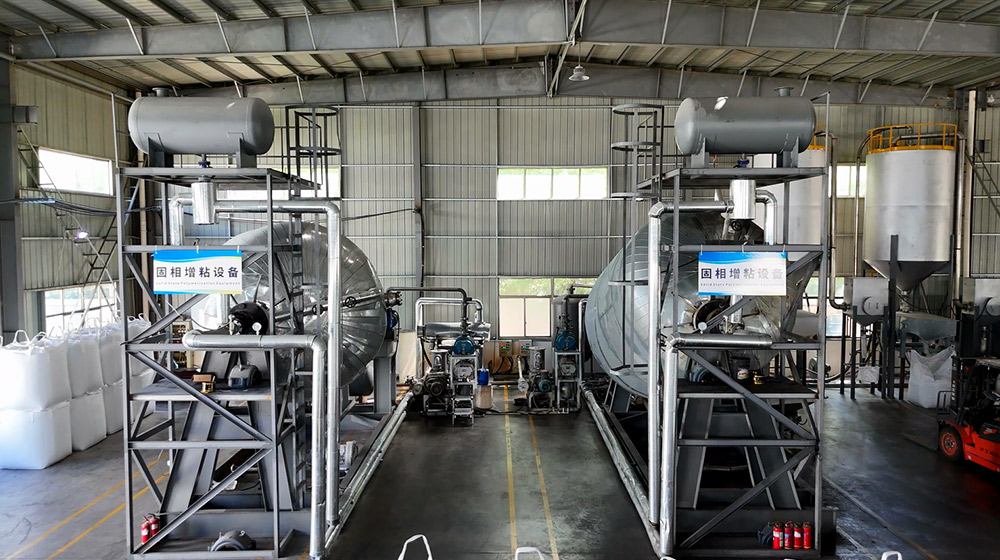
Solid-state polymerization is part of the PET strap process; raw-material IV control supports finished-strap consistency.
Use Cases: Where Green Cut PET Strapping Fits
Viscose fiber bales: the Sateri reference
Sateri (China) Fiber Co., Ltd. is a documented user of 1610 × 3380/3480 green PET strap for viscose fiber bale strapping. The case record states that multiple batches were supplied over three years and consistently met Sateri’s quality standards, with documented purchase invoices. This is the clearest available evidence that the format is not theoretical: it is a repeat-supply program for a fiber bale application.
The Sateri case is useful precisely because it combines the three variables in this article. The strap is green, so it supports identification. It is PET, so it brings low elongation to a compressed fiber bale. It is cut to 3380 mm or 3480 mm, so it matches the baling line rather than a generic roll. A buyer evaluating a new supplier can use the same format as a benchmark, then verify that the supplier’s resin, color, cut length and test reports are equivalent.
Chemical fiber bale contracts with multiple cut lengths
A separate annual contract covers green cut PET strap in 19 × 1.0 × 3430 mm and 16 × 1.0 × 3430 mm for chemical fiber bale strapping, with 40,000+ pieces per order and a raw-material-linked pricing mechanism. This case shows that cut-length programs often involve more than one format. The 19 mm and 16 mm straps are not interchangeable; they serve different bale or line requirements within the same customer relationship.
For procurement, the lesson is to build a format matrix rather than a single line item. The matrix should list width, thickness, cut length, color, break force, elongation, pieces per bundle, packaging and annual volume. That makes it possible to compare quotations without mixing formats. It also makes it easier to audit a shipment: a 19 × 1.0 × 3430 mm piece should not be accepted against a 16 × 1.0 × 3430 mm purchase line.
Raw-material supply for strapping production
Green cut PET strapping is a finished product, but it depends on a raw-material chain. The 26,000 kg PET granule export to Thailand for strapping production is a useful example of that chain. The shipment was accompanied by a 0% VAT invoice and met the quality specifications for strapping production. For buyers, this is a reminder that supplier capability can be assessed at two levels: finished-strap manufacturing and raw-material sourcing discipline.
Jushuo Packaging reports 4 PET strap production lines, 5 PP strap production lines and 2 sets of solid-state polymerization equipment, with annual capacity exceeding 20,000 tons. The company also reports a 15,000 m² factory and 54 employees. These are company-reported figures, but they explain why a cut-length program can be scaled: the same plant controls resin preparation, extrusion, stretching, annealing, slitting and winding before the strap is cut to length.
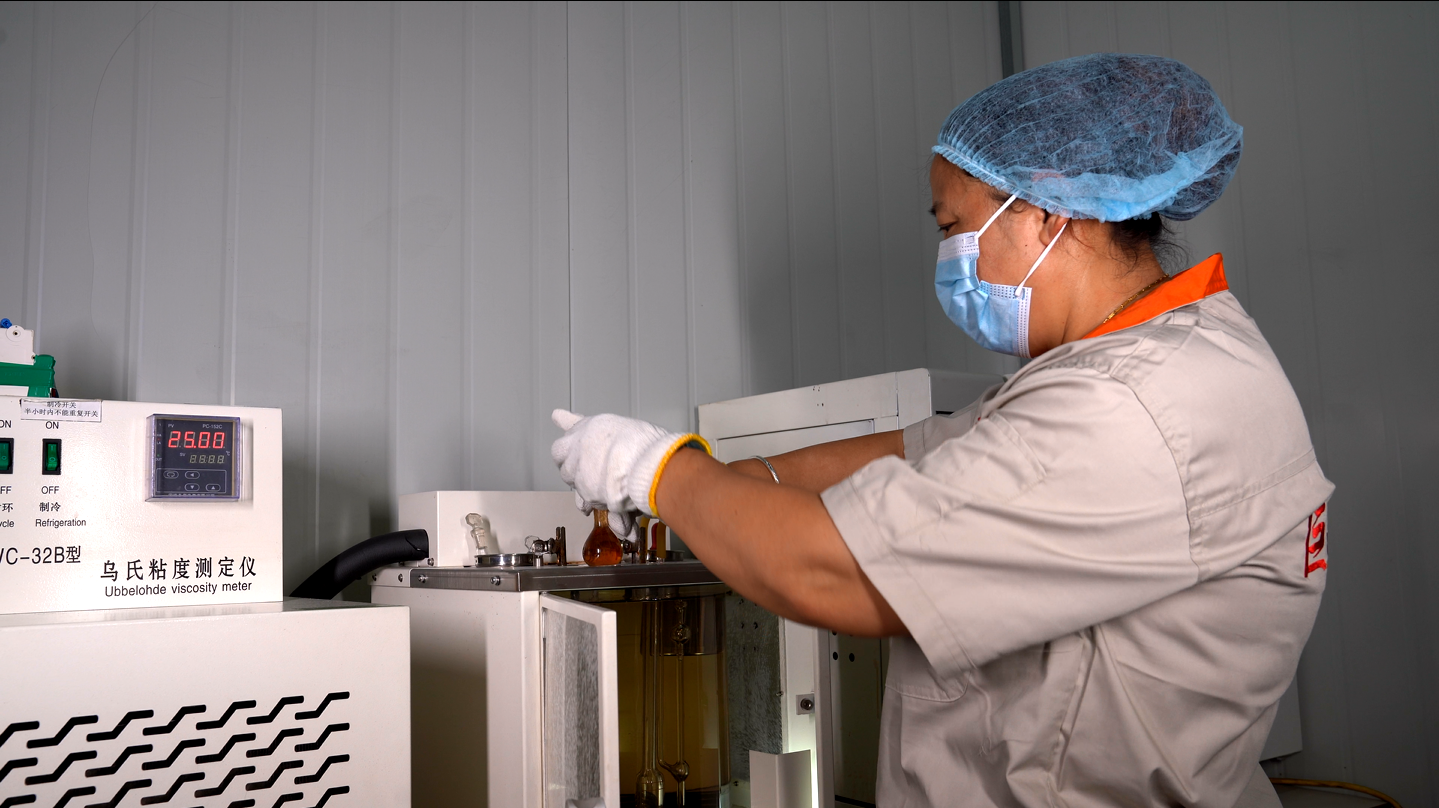
Intrinsic viscosity testing supports raw-material control before PET strap extrusion.
Comparison Table: Green Cut PET vs Standard PET vs PP for Bale Strapping
The table below compares the material families using product data and case facts. It is not a brand ranking. It is a specification aid: the correct choice depends on bale compression, cut length, machine interface and the required identification system.
| Attribute | Green cut PET strapping | Standard PET strap (roll) | PP strap |
|---|---|---|---|
| Base material | PET with green color masterbatch | PET | Polypropylene |
| Typical width | 9–25 mm | 9–25 mm | 5–19 mm |
| Typical thickness | 0.40–1.27 mm | 0.40–1.27 mm | 0.35–0.90 mm |
| Break force range | 160–1360 kg | 160–1360 kg | 45–270 kg |
| Elongation | ≤10% | ≤10% | 15–20% standard; ≤15% high-strength |
| Color and identification | Green masterbatch; used for bale or grade identification | Clear, green, black or custom | Clear, white, green, black or custom |
| Supply format | Cut length, e.g. 3380 mm or 3480 mm; roll form also available | Roll, 550–3800 m, 406 mm core | Roll or hand coil |
| Typical fit | Fiber bale lines needing color coding and a fixed cut length | Heavy-load unitizing where a roll is preferred | Light to medium loads and general bundling |
Table notes: ranges are product-family ranges and vary by width and thickness. A specific 16 × 1.0 mm cut-length strap must be quoted and tested at its own format. PP elongation values are from standard and high-strength PP product data.
Quality, Compliance and Supplier Capability
Green cut PET strapping should be bought with the same compliance discipline as any other packaging material. Jushuo Packaging reports ISO 9001, ISO 14001 and ISO 45001 certification, and states that PET strap complies with GB/T 22344-2018. Third-party SGS or CMA test reports are available on request. These claims should be verified against current certificates and the specific test report for the quoted format.
The company describes six inspection procedures: raw-material inspection, incoming inspection, online inspection, finished-product inspection, inbound inspection and outbound inspection. It also reports a finished-product qualification rate above 99% and a 98.6% on-time shipment rate. Both are company-reported metrics; they are useful as supplier questions, not as independent industry benchmarks. Buyers should ask for the inspection record that corresponds to the green cut PET batch, including width, thickness, cut length, break force and elongation.
Capability for custom cut-length programs is supported by the company’s OEM/ODM service description. Customization covers color, width, thickness, length, surface finish, core size and custom logo printing. For a green cut PET program, the relevant customization fields are width, thickness, cut length, green color, packaging and any customer-specific printing. The supplier’s stated lead time for chemical fiber bale applications is 7–20 days; stock specifications can ship in about 7 days, while custom formulations may take 30–60 days and pilot trials 45–90 days.
FAQ
Is green cut PET strapping compliant with GB/T 22344-2018 and supported by test reports?
Jushuo Packaging states that its PET strap complies with GB/T 22344-2018 and that the company operates ISO 9001, ISO 14001 and ISO 45001 systems. Third-party SGS or CMA test reports are available on request. For a specific green cut PET format, ask for the report that matches the quoted width, thickness and cut length, not only a generic product certificate. The Sateri program is a useful reference because multiple batches were supplied over three years and consistently met the customer’s quality standards.
Can Jushuo Packaging produce green PET strap cut to 3380 mm or 3480 mm for fiber bale lines?
Yes. Customized PET strap banding includes custom width, thickness, length, core size, color and printing. The documented Sateri order uses 1610 × 3380/3480 green PET strap for viscose fiber bale strapping. A separate annual contract covers 19 × 1.0 × 3430 mm and 16 × 1.0 × 3430 mm green cut PET strap for chemical fiber bale strapping, with 40,000+ pieces per order. Buyers should provide the bale dimensions, machine interface and target piece length so the cut-length program can be confirmed.
How should buyers budget for green cut PET strapping?
There is no single list price for green cut PET strapping. Cost depends on width, thickness, cut length, green color, packaging, order volume and the PET resin price at the time of order. The annual green cut PET contract referenced in the case record used a raw-material-linked pricing mechanism, which is one way to manage resin volatility. A useful quotation request should state the full format, estimated annual volume, delivery terms and whether the buyer needs neutral or branded packaging.
Can buyers request a sample before placing a green cut PET strap order?
Yes. The supplier’s sample policy is free samples with freight collect, and trial straps are available for batch orders. The stated MOQ is 1 ton, with 200 kg accepted for small trial orders. A sample should be tested at the actual cut length, because a short piece cannot prove feeding and sealing performance on a baling line. Include the target width, thickness, color, cut length and test method in the sample request.
What is the lead time for a custom green cut PET strapping order?
For chemical fiber bale applications, the stated lead time is 7–20 days. Stock specifications can ship in about 7 days; custom formulations may take 30–60 days, and pilot trials 45–90 days. The exact schedule depends on the cut length, color approval, order quantity and current production loading. Send the full format, annual volume and required delivery date through jushuopackaging.com to confirm the production slot and sample plan.
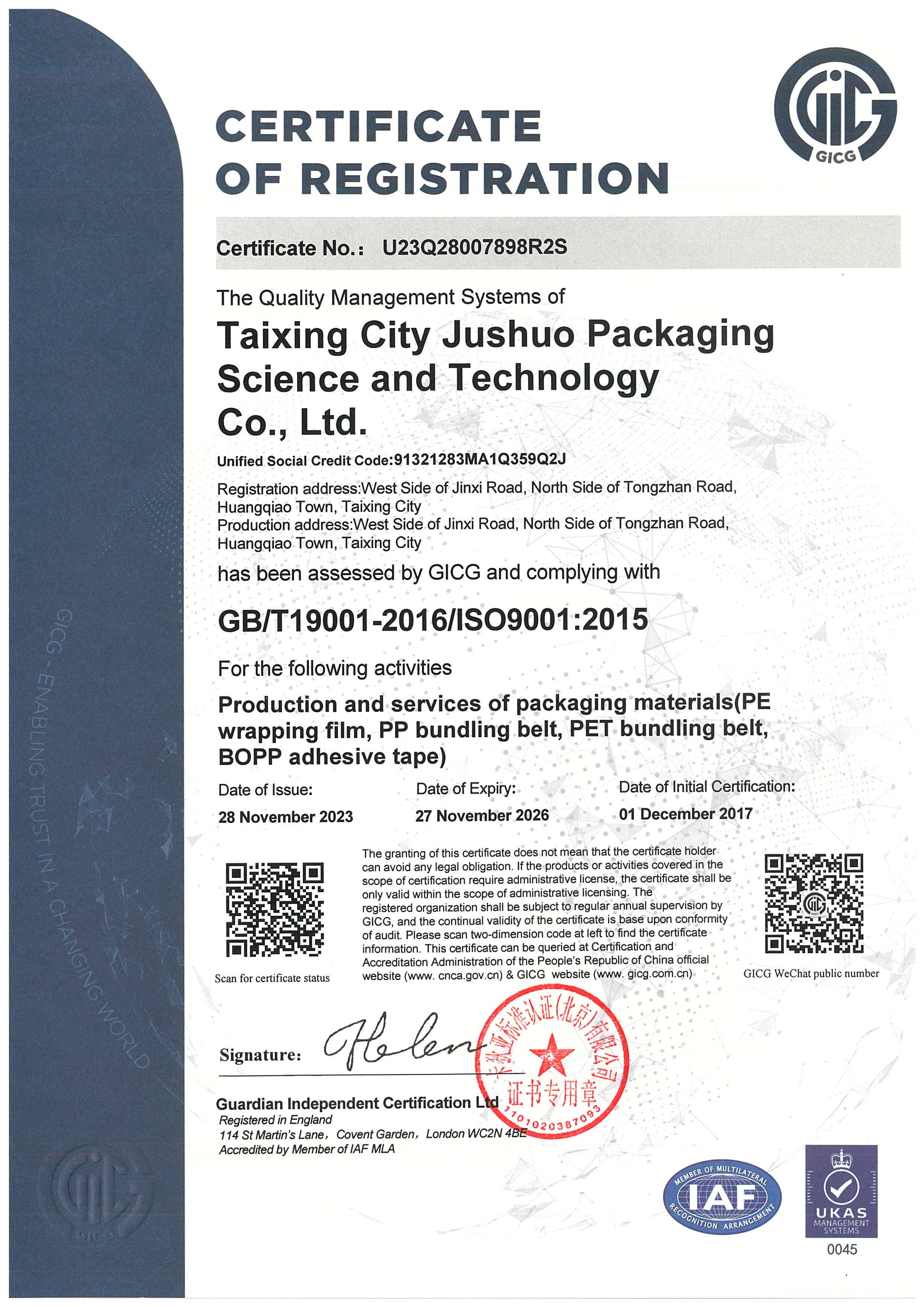
Request the current ISO certificate, the format-specific test report and a cut-length sample before approving a green cut PET strapping program.
Conclusion
Green cut PET strapping is best understood as a matched set of attributes: PET resin with controlled IV and moisture, green masterbatch for identification, a cut length that fits the baling head, and a width-thickness combination that delivers the required break force and elongation. The Sateri record, with multiple batches of 1610 × 3380/3480 green PET strap over three years, shows what a stable program looks like. The annual 19 × 1.0 × 3430 mm and 16 × 1.0 × 3430 mm contract shows why a format matrix matters.
For buyers, the next step is not to ask for green PET strap in general. It is to send the bale dimensions, machine interface, target cut length, width, thickness, color standard and annual volume. Jushuo Packaging’s product and customization details are available at https://www.jushuopackaging.com/. A sample run at the actual cut length is the cheapest way to confirm that the specification will work on the line.
Have Questions or Need More Details?
Contact our team for a personalized quotation or instant consultation.
Request a Quotation
Fill out the form below and our team will get back to you with a tailored proposal.
WhatsApp Direct Chat
Prefer to chat in real-time? Message us on WhatsApp for instant assistance & quick answers.
- Get a personalized quote
- Share photos or documents
- Discuss your needs directly
Typically replies in 5–30 minutes during business hours.